

Back to blogs

Customer Data and Analytics

Customer Data and Analytics

Customer Data and Analytics

Which Attribution Model Should You Use? What Changes When You Switch

Anil Bains

Founder and CEO

By

Anil Bains

Founder and CEO

1 min read

Statistical Analysis of KPIs to improve performance marketing
Table Of Contents

Share with your community:

TABLE OF CONTENTS
Table of ContentS

Make your next customer interaction count.

See how Attryb makes every journey more relevant.

TLDR

  • An attribution model is a rule for splitting credit between the touches in a journey. Change the rule, and a different channel looks best. Nothing in the business has changed. 

  • Pick the model that fits the decision you are making. First touch for discovery questions. Last touch for closing questions. Multi-touch for budget questions. 

  • Most tools default to last click. Nobody at your company picked it. 

  • The data underneath matters more than the model on top. A model can only split what it can see. 

Introduction

Most people reach attribution modeling after an argument. Two channels claim the same order. Changing the model changes channel rankings.

The obvious question is which model is correct. That question has no answer. The better question is which model answers what you are trying to decide.

Read the definitions of all the attribution models at Advanced Attribution Models: Moving Beyond Last-Click. What follows assumes you know roughly what each one does.

What does an attribution model decide?

A model takes the list of touches that led to an order and decides how much credit each touch will get. That is the whole job.
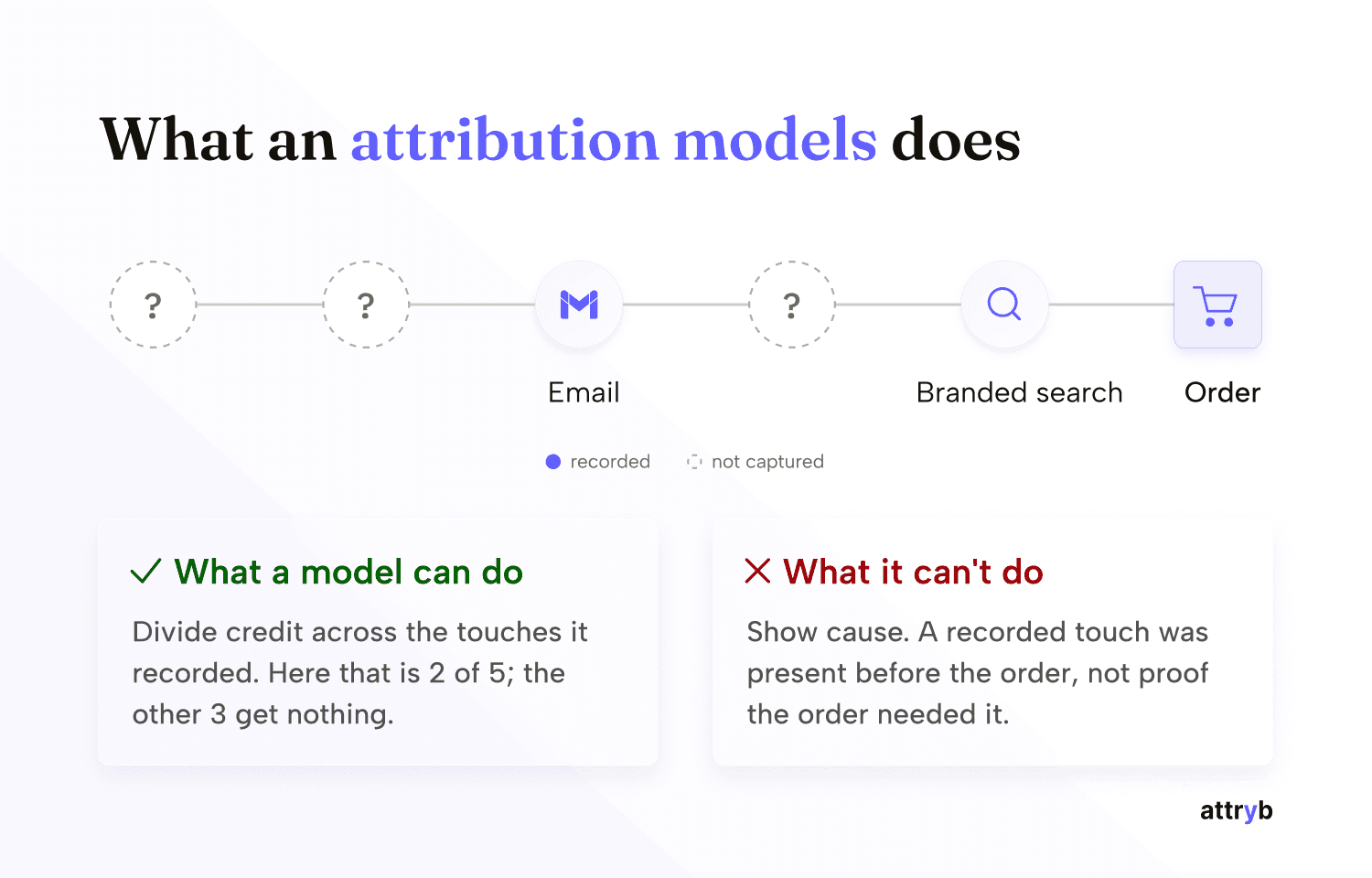
Marketing attribution model diagram showing a customer journey of five touchpoints where only two are recorded (email and branded search) before an order, illustrating how attribution models can only divide credit across recorded touches and cannot prove which touch caused the sale.

Two things follow from this that people get wrong.

  1. A model cannot add information. It can only divide what is already recorded. Say a journey really had five touches and your data caught two. Every model will split the order across those two touches, and every model will be wrong.

  2. A model does not tell you what caused the sale. A touch is a record that something happened before someone bought. First click tells you what was there at the start. It does not tell you the order would have failed without it. That is a different question, and it needs different methods.

What happens to your channel report when you change attribution models?

Here is one month for one brand, run through three models. Same 6,360 orders. Same seven channels. Only the credit rule changed.


Channel

First Click

Last Click

Linear

Direct

970

1,140

1,890

Google Ads

1,880

1,220

1,030

Google Search

860

1,390

1,370

Meta Organic

980

1,100

840

Meta Ads

800

720

620

Email

680

700

540

Creator Program

190

90

70

Total

6,360

6,360

6,360

Two things stand out.

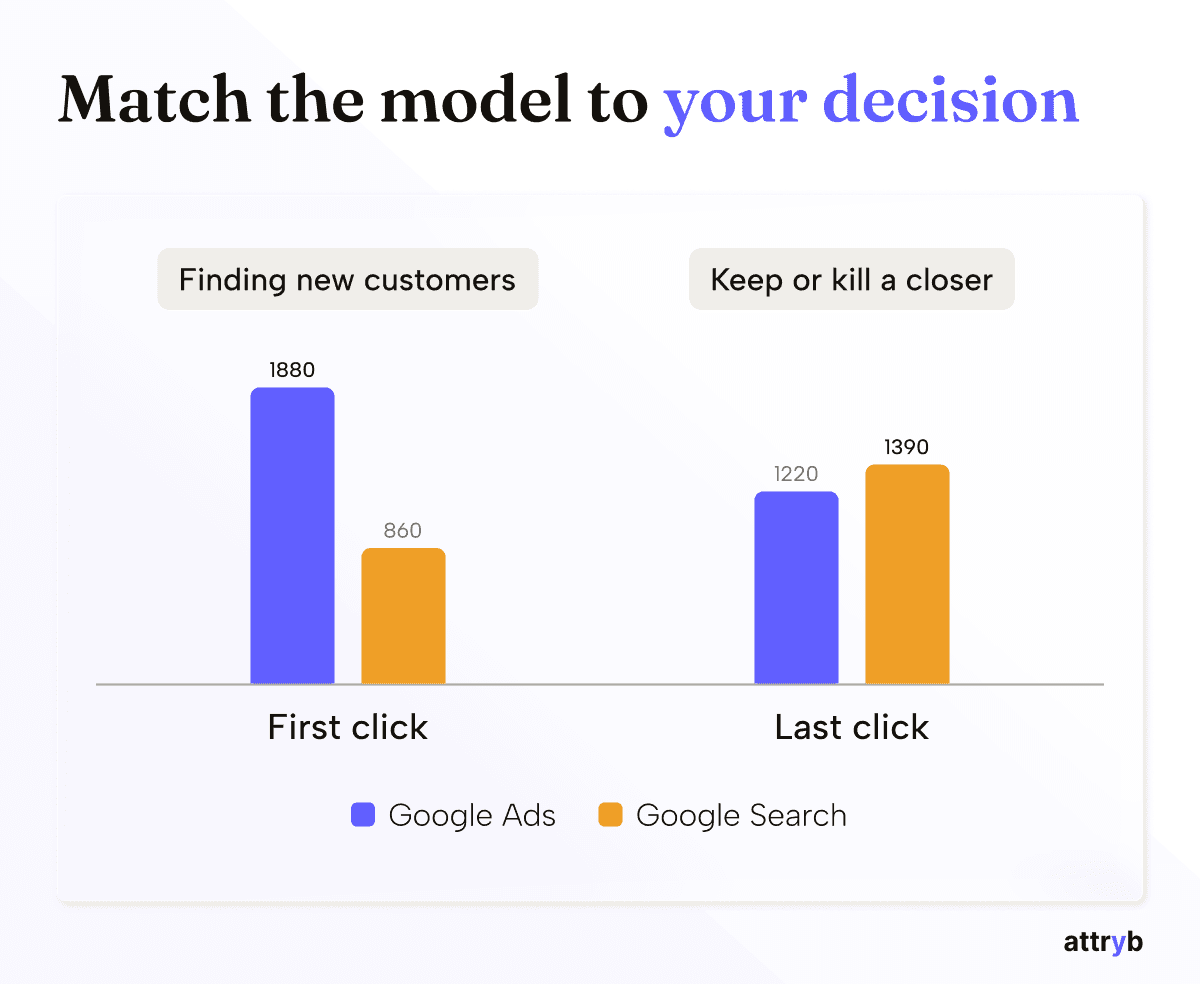
  1. The best channel changes. Google Ads is the clear leader under first click with 1,880 orders. Under last click, it falls to second behind Google Search. Anyone reporting "our biggest channel" is reporting a dropdown setting.

  2. Google Ads loses 660 orders when we change models. Under first click, it holds 1,880 of the 6,360 orders, which is 29.6% of the total. Under last click, it holds 1,220 which is 19.2%. A third of the channel's credit disappears because we changed the models.

That matters if you budget on rules like "Google Ads should drive a quarter of our orders." Under one model, it clears the bar. Under the other, it misses, and someone proposes a cut.
Why your best channel changes depending on the attribution model?

The swing is not random. It shows you where each channel sits in the journey.

Channels that fall when you move from first click to last click are opening journeys. The creator program drops 53%. Google Ads drops 35%.

Channels that rise are closing them. Google Search goes from 860 to 1,390, a rise of 62%. Someone who searches your brand name and buys was sent there by something else. Search caught the order. Search did not create the demand.

Some channels barely move. Meta Ads sits at 800 and 720. Email sits at 680 and 700. A flat channel is either doing both jobs at once, or it shows up on short journeys where the first touch and the last touch are the same touch.

A single model tells you how big a channel is. The gap between two models tells you what that channel does.

Under linear the biggest line is Direct at 1,890 orders, or 29.7% of the total. You cannot buy Direct. It is a leftover bucket that is assigned to any order that can't be cleanly attributed to any channel. Linear spreads credit evenly across every touch, so it always inflates whatever bucket shows up most often. In most stores that bucket is Direct.

Which attribution model to use for which decision?

The attribution model you pick depends on the question you're trying to answer

  • Finding new customers. Use first click. You want to know what starts journeys, and every other model undercredits the channels that do this. Any channel that looks weak on last click and strong on first click is bringing people in. Cut it and you break your own discovery.

  • Keeping or killing a closing channel. Use last click. Retargeting, branded search and cart-abandonment email all exist to convert demand that already exists. Last click is the model most generous to them, so if one of them looks weak even under last click, it is genuinely weak. If Direct is swallowing a large share of your last touches, use last non-direct instead, which skips Direct and credits the last channel you can actually name.

  • Splitting next quarter's budget. Use a multi-touch model. Budget decisions involve channels that never get the first or last touch, and single-touch models make those channels disappear. Linear splits credit evenly and is the simplest way to find mid-journey channels you have been ignoring. Position-based weights the two ends and suits brands where discovery and conversion are run by different teams. Data-driven learns the split from your own data and needs a lot of orders before it learns anything. Time decay favours recent touches and only fits short buying cycles, promotions and flash sales.

Whichever you pick, check how much credit lands in buckets you cannot spend against.

  • Choosing between two creatives or two campaigns. Use whatever the ad platform uses. Platform numbers are unreliable for comparing across channels. They are fine for comparing two things inside one channel, because the same bias applies to both.

  • Understanding how much your channels overlap. Use any touch. This one is not an allocation model and is not meant to total to your order count. It credits every channel present in a journey.

  • Deciding whether a channel is worth anything at all. No model answers this. Attribution records touches. Whether the order needed the touch is a causal question, and the methods that answer it are covered separately.

Why last click is your default, and why that is not a decision you made?

Most stores run last click or last non-direct without ever choosing it. Shopify, Meta and most ad platforms ship with a last-touch default, and defaults survive.

Last click became the default because it is easy to compute and hard to argue with. It needs one touch and no journey rebuilt. Every other model needs the full path, and most systems do not hold the full path reliably.

The cost is that last click always rewards whatever sits closest to the purchase. On this brand's numbers, Google Search and Direct together take 2,530 orders under last click, or 39.8% of the total. Both are simply converting the demand that something else created.

If you have never changed the setting, you are running the model that was easiest to build. That can still be the right call.

When is a custom attribution model worth building?

Custom models come up once a team has tried the standard set and none of them fit. One of three things usually triggers it.

  1. An unusual journey shape. Long consideration cycles, high repeat rates or a big offline component all break assumptions built into off-the-shelf models.

  2. A channel that matters more than its credit. Creator programs, podcasts and referral schemes tend to sit in the middle of journeys, and every standard model underweights the middle.

  3. A decision you make over and over. If you reallocate budget across eight channels every month, a model built for that decision can earn its cost.

Custom is worth less than people expect. Custom weights applied to incomplete journeys gives you a more specific version of the same data. Build the data first, then the model. Most teams skip that order.

How to test attribution models on your own data before you commit

Four checks.

  1. Run first click and last click side by side for one month. Sort your channels by the difference between the two. Anything that moves more than 20% has a job in the journey you should know about before you set budgets again.

  2. Count your channels per order. Divide total channel touches by order count. Under 1.3 and model choice barely affects you. Over 2.0 and it shapes your whole report.

  3. Check where Direct lands under each model. If Direct grows as you move toward multi-touch models, your journey data is thin, and the model is pushing credit into a bucket you cannot act on.

Check the totals. Any allocation model should total to your actual order count for the period.

Frequently Asked Questions

01

What is an attribution model?

02

What are the main types of attribution models?

03

What is multi-touch attribution, and when should you use it?

04

Why do Shopify, GA4, and Meta report different numbers for the same channel?

05

Which attribution model do most marketers actually use?

06

How do you build a multi-touch attribution model?

07

What is revenue attribution, and how is it different?

08

How can I see which channel actually caused a sale?

09

What should you look for in attribution modeling software?

Introduction

Most people reach attribution modeling after an argument. Two channels claim the same order. Changing the model changes channel rankings.

The obvious question is which model is correct. That question has no answer. The better question is which model answers what you are trying to decide.

Read the definitions of all the attribution models at Advanced Attribution Models: Moving Beyond Last-Click. What follows assumes you know roughly what each one does.

What does an attribution model decide?

A model takes the list of touches that led to an order and decides how much credit each touch will get. That is the whole job.

Marketing attribution model diagram showing a customer journey of five touchpoints where only two are recorded (email and branded search) before an order, illustrating how attribution models can only divide credit across recorded touches and cannot prove which touch caused the sale.

Two things follow from this that people get wrong.

  1. A model cannot add information. It can only divide what is already recorded. Say a journey really had five touches and your data caught two. Every model will split the order across those two touches, and every model will be wrong.

  2. A model does not tell you what caused the sale. A touch is a record that something happened before someone bought. First click tells you what was there at the start. It does not tell you the order would have failed without it. That is a different question, and it needs different methods.

What happens to your channel report when you change attribution models?

Here is one month for one brand, run through three models. Same 6,360 orders. Same seven channels. Only the credit rule changed.


Channel

First Click

Last Click

Linear

Direct

970

1,140

1,890

Google Ads

1,880

1,220

1,030

Google Search

860

1,390

1,370

Meta Organic

980

1,100

840

Meta Ads

800

720

620

Email

680

700

540

Creator Program

190

90

70

Total

6,360

6,360

6,360

Two things stand out.

  1. The best channel changes. Google Ads is the clear leader under first click with 1,880 orders. Under last click, it falls to second behind Google Search. Anyone reporting "our biggest channel" is reporting a dropdown setting.

  2. Google Ads loses 660 orders when we change models. Under first click, it holds 1,880 of the 6,360 orders, which is 29.6% of the total. Under last click, it holds 1,220 which is 19.2%. A third of the channel's credit disappears because we changed the models.

That matters if you budget on rules like "Google Ads should drive a quarter of our orders." Under one model, it clears the bar. Under the other, it misses, and someone proposes a cut.

Why your best channel changes depending on the attribution model?

The swing is not random. It shows you where each channel sits in the journey.

Channels that fall when you move from first click to last click are opening journeys. The creator program drops 53%. Google Ads drops 35%.

Channels that rise are closing them. Google Search goes from 860 to 1,390, a rise of 62%. Someone who searches your brand name and buys was sent there by something else. Search caught the order. Search did not create the demand.

Some channels barely move. Meta Ads sits at 800 and 720. Email sits at 680 and 700. A flat channel is either doing both jobs at once, or it shows up on short journeys where the first touch and the last touch are the same touch.

A single model tells you how big a channel is. The gap between two models tells you what that channel does.

Under linear the biggest line is Direct at 1,890 orders, or 29.7% of the total. You cannot buy Direct. It is a leftover bucket that is assigned to any order that can't be cleanly attributed to any channel. Linear spreads credit evenly across every touch, so it always inflates whatever bucket shows up most often. In most stores that bucket is Direct.

Which attribution model to use for which decision?

The attribution model you pick depends on the question you're trying to answer

  • Finding new customers. Use first click. You want to know what starts journeys, and every other model undercredits the channels that do this. Any channel that looks weak on last click and strong on first click is bringing people in. Cut it and you break your own discovery.

  • Keeping or killing a closing channel. Use last click. Retargeting, branded search and cart-abandonment email all exist to convert demand that already exists. Last click is the model most generous to them, so if one of them looks weak even under last click, it is genuinely weak. If Direct is swallowing a large share of your last touches, use last non-direct instead, which skips Direct and credits the last channel you can actually name.

  • Splitting next quarter's budget. Use a multi-touch model. Budget decisions involve channels that never get the first or last touch, and single-touch models make those channels disappear. Linear splits credit evenly and is the simplest way to find mid-journey channels you have been ignoring. Position-based weights the two ends and suits brands where discovery and conversion are run by different teams. Data-driven learns the split from your own data and needs a lot of orders before it learns anything. Time decay favours recent touches and only fits short buying cycles, promotions and flash sales.

Whichever you pick, check how much credit lands in buckets you cannot spend against.

  • Choosing between two creatives or two campaigns. Use whatever the ad platform uses. Platform numbers are unreliable for comparing across channels. They are fine for comparing two things inside one channel, because the same bias applies to both.

  • Understanding how much your channels overlap. Use any touch. This one is not an allocation model and is not meant to total to your order count. It credits every channel present in a journey.

  • Deciding whether a channel is worth anything at all. No model answers this. Attribution records touches. Whether the order needed the touch is a causal question, and the methods that answer it are covered separately.

Why last click is your default, and why that is not a decision you made?

Most stores run last click or last non-direct without ever choosing it. Shopify, Meta and most ad platforms ship with a last-touch default, and defaults survive.

Last click became the default because it is easy to compute and hard to argue with. It needs one touch and no journey rebuilt. Every other model needs the full path, and most systems do not hold the full path reliably.

The cost is that last click always rewards whatever sits closest to the purchase. On this brand's numbers, Google Search and Direct together take 2,530 orders under last click, or 39.8% of the total. Both are simply converting the demand that something else created.

If you have never changed the setting, you are running the model that was easiest to build. That can still be the right call.

When is a custom attribution model worth building?

Custom models come up once a team has tried the standard set and none of them fit. One of three things usually triggers it.

  1. An unusual journey shape. Long consideration cycles, high repeat rates or a big offline component all break assumptions built into off-the-shelf models.

  2. A channel that matters more than its credit. Creator programs, podcasts and referral schemes tend to sit in the middle of journeys, and every standard model underweights the middle.

  3. A decision you make over and over. If you reallocate budget across eight channels every month, a model built for that decision can earn its cost.

Custom is worth less than people expect. Custom weights applied to incomplete journeys gives you a more specific version of the same data. Build the data first, then the model. Most teams skip that order.

How to test attribution models on your own data before you commit

Four checks.

  1. Run first click and last click side by side for one month. Sort your channels by the difference between the two. Anything that moves more than 20% has a job in the journey you should know about before you set budgets again.

  2. Count your channels per order. Divide total channel touches by order count. Under 1.3 and model choice barely affects you. Over 2.0 and it shapes your whole report.

  3. Check where Direct lands under each model. If Direct grows as you move toward multi-touch models, your journey data is thin, and the model is pushing credit into a bucket you cannot act on.

Check the totals. Any allocation model should total to your actual order count for the period.

Frequently Asked Questions

01

What is an attribution model?

02

What are the main types of attribution models?

03

What is multi-touch attribution, and when should you use it?

04

Why do Shopify, GA4, and Meta report different numbers for the same channel?

05

Which attribution model do most marketers actually use?

06

How do you build a multi-touch attribution model?

07

What is revenue attribution, and how is it different?

08

How can I see which channel actually caused a sale?

09

What should you look for in attribution modeling software?

Share:

Share:

Founder and CEO

Founder and CEO of Attryb Tech. A seasoned entrepreneur who brings over a decade of experience to Attryb. He also loves traveling - 43 countries and counting - and used to be pretty good at Volleyball: he captained at Volleyball Nationals Under-17 team!

Put every customer signal to work.

Turn fragmented journeys into meaningful, measurable experiences.