
Back to blogs

Marketing and Growth

Marketing and Growth

Marketing and Growth

What Marketing Attribution Is, and What It Can Actually Tell You

Anil Bains

Founder and CEO

By

Anil Bains

Founder and CEO

1 min read

Statistical Analysis of KPIs to improve performance marketing
Table Of Contents

Share with your community:

TABLE OF CONTENTS
Table of ContentS

Make your next customer interaction count.

See how Attryb makes every journey more relevant.

TLDR

  • Marketing attribution is the practice of deciding which marketing touches get credit for a sale. That is the whole definition. 

  • It runs in four stages: collect the touch, name the channel, rebuild the journey, split the credit. Most attribution problems happen in stage two, not stage four. 

  • One D2C brand had 1,159,710 sessions and 6,360 orders in a month. That is 182 sessions per order. Attribution is the work of connecting the two numbers. 

  • Meta, Google, and Klaviyo together claimed 9,400 of those 6,360 orders. Attribution answers how and why. 

  • Attribution tells you which channels were present before a sale. It does not tell you which ones caused it. Those are different questions with different methods. 

  • Attribution starts to matter once you run more than two channels, because that is when journeys start to overlap. 

Introduction

Marketing attribution is the practice of deciding which marketing touches get credit for a sale. A customer sees an ad, opens an email, clicks a search result, and buys. Attribution is the work of deciding which of those things gets the credit, and how much.

Everything else is detail about how you do it.

Why marketing attribution matters for a growing store

Attribution exists to answer one question: where should the next dollar of the marketing budget go?

If you run one channel, you don't need attribution. Spend went to Meta, orders came in, the arithmetic is obvious.

The moment you run three or four channels, the arithmetic breaks. Customers touch several channels before buying. Each platform sees only its own touch and reports the whole sale as its own. Add the reports together, and you get more sales than your store made.
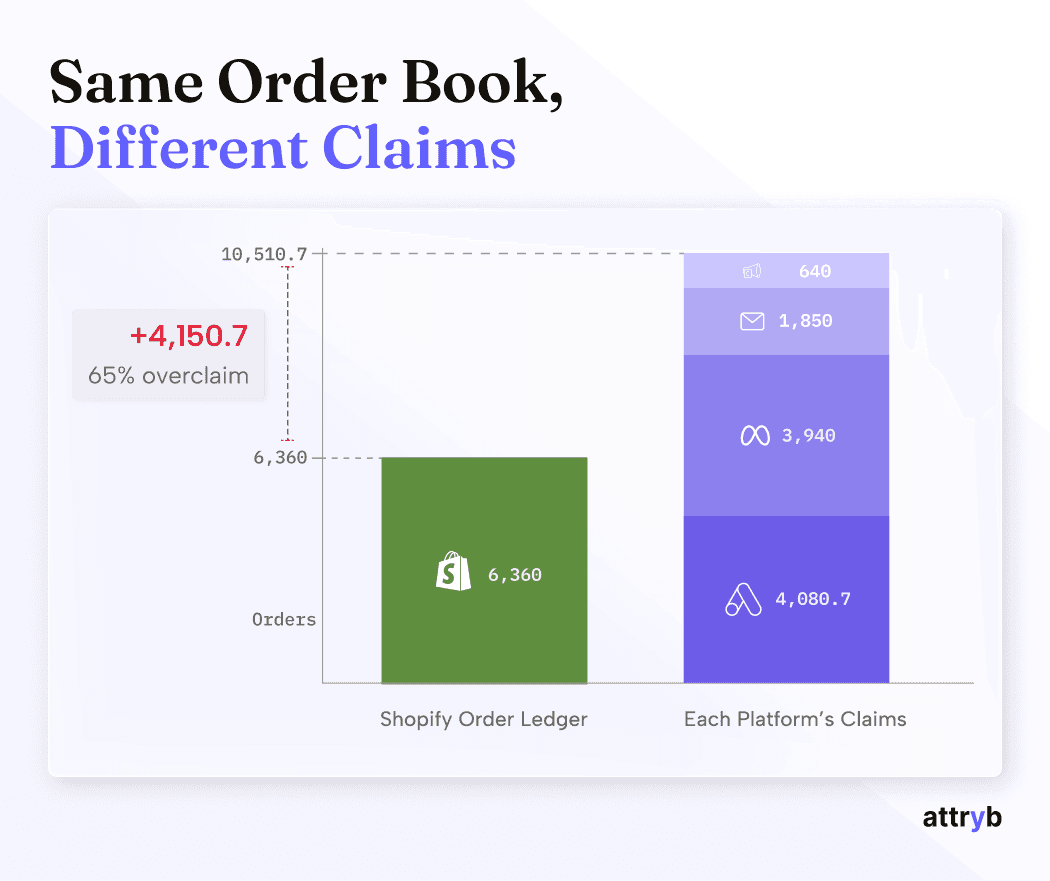
Image showing the difference between the total orders across marketing platforms and the actual number of orders the store served.
Figure 1. Ad platforms claiming every orders means the total claim exceeds orders served

Here is the scale of the problem at one D2C brand. In one month, the store recorded 1,159,710 sessions and 6,360 orders, roughly one order for every 182 sessions. Attribution helps determine which session sources deserve the credit for the sale.

How marketing attribution works: the four stages

Every attribution system, whether it is Shopify's built-in reports or a dedicated platform, does the same four things in the same order.

  1. Stage one: collect the touch. Someone arrives on your site, and the system records what it can. A UTM tag in the URL. A click ID from an ad platform. The referring website. If none of those exist, it records that too.

  2. Stage two: name the channel. The system turns that raw signal into a channel name. A UTM saying utm_source=klaviyo becomes Email. A referrer of google.com becomes Organic Search. Anything it cannot read becomes Unknown.

  3. Stage three: rebuild the journey. The system links the sessions belonging to one person into a single path. Someone who visited four times over three weeks should end up as one journey with four touches, not four separate strangers.

  4. Stage four: split the credit. A rule assigns credit across those touches. This rule is the attribution model, and choosing one is its own decision.
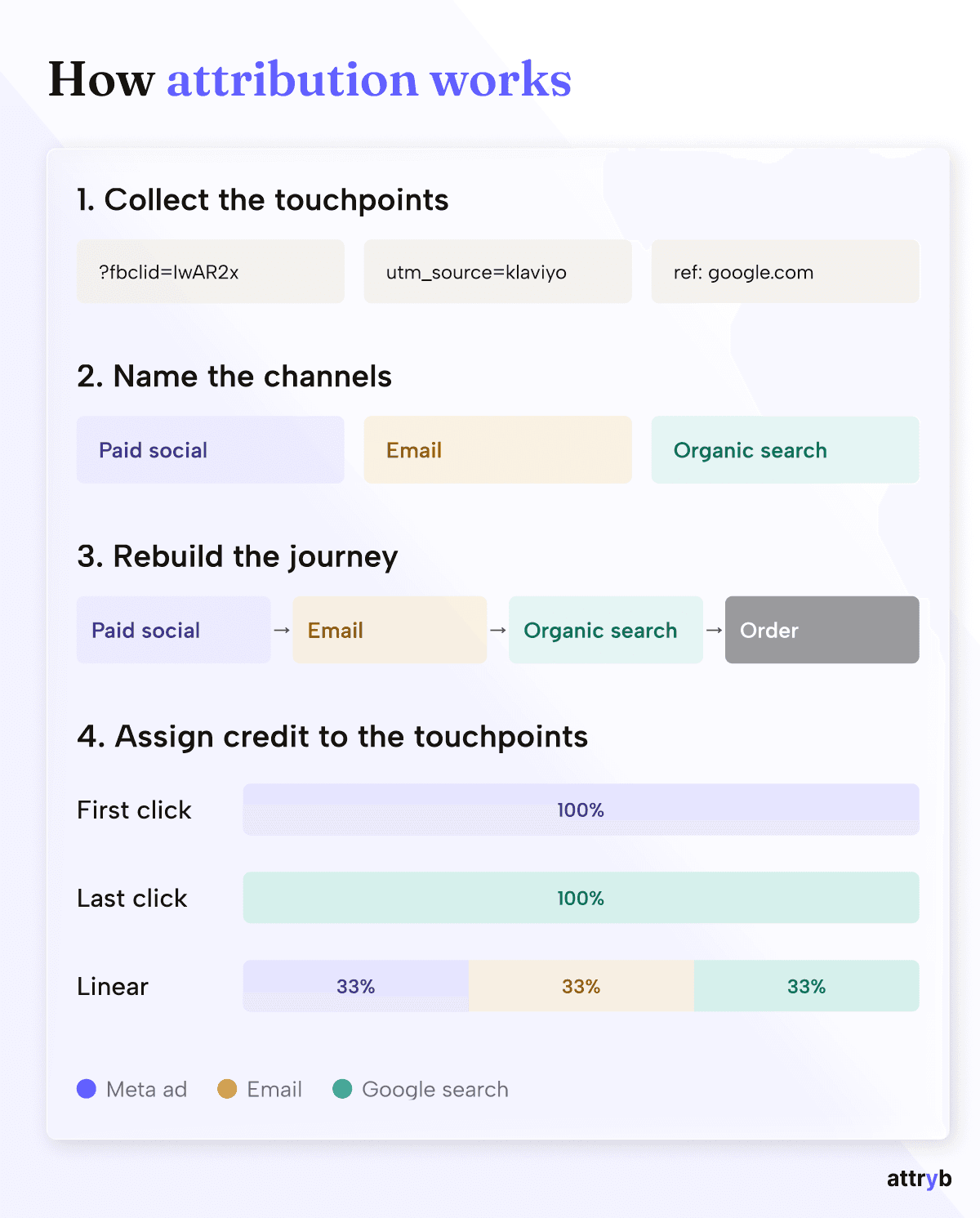
Marketing attribution diagram showing the four stages, collecting the raw signal, naming the channel, rebuilding one buyer's journey, and splitting credit across first click, last click, and linear models
Figure 2. How marketing attribution works

Almost every argument about attribution happens at stage four. Almost every real problem lives at stage two.

At the brand above, 63.5% of those sessions could not be given a channel a marketer could act on. They landed in Direct or Unknown. No model applied at stage four can fix that, because the channel name it needs was never recorded. We take apart why this happens in Why is my Shopify direct traffic so high?.

Where marketing attribution data comes from

Attribution data comes from two sources:

  1. Your website. Every visit leaves a record of how the person arrived. This is the richest source and the most fragile. Ad blockers, privacy settings, and in-app browsers all strip parts of it.

  2. The ad platforms. Meta, Google, and TikTok each know who they showed ads to and which of those people later bought. Each one sees its own touches and nothing else.

Ad platforms are where most confusion starts. A platform reporting 400 sales is telling you 400 buyers touched that platform. It is not telling you those 400 buyers touched nothing else.

Good attribution uses the first source as the base and treats the second as a claim to be checked.

What counts as a touch in marketing attribution

A touch is any recorded interaction between a person and your marketing before they buy.

Clicks always count. Someone clicked an ad, an email link, or a search result and landed on your site. This leaves a clear record.

Views sometimes count. Someone saw an ad and didn't click, then bought later. Ad platforms count this as their own. Most independent systems do not, because they can't confirm the person ever saw it.

Offline touches usually do not count. A podcast mention or a billboard ad leaves no digital record, so nothing downstream can see it.

Attribution measures what it can observe. A channel that leaves no digital trace will be undercounted by every model, every tool, and every vendor. That is a limit of the method, not a flaw in your setup.

Single-touch and multi-touch attribution: the basic split

Attribution models divide into two families.

  1. Single-touch models give all the credit to one touch. First click credits the touch that introduced the customer. Last-click credits the touch closest to the purchase. These are simple, easy to explain, and easy to argue with.

  2. Multi-touch models spread credit across several touches. Linear splits it evenly. Position-based weights the first and last more heavily. Data-driven models learn the split from patterns in your own data.

Single-touch models are exact about one thing and silent about everything else. Multi-touch models describe more of the journey.

Full definitions of each model are in Advanced Attribution Models. Which one to use for which decision is covered in Which attribution model should you use.

How attribution works for channels that are hard to track

Three channels resist attribution more than the rest.

  1. Content and SEO. Someone reads a blog post, leaves, and comes back a month later through a branded search. Attribution sees the search and often misses the post. This is why content looks weaker than it is under last click.

  2. Influencer and creator programs. These usually run on discount codes rather than links. A code redeemed at checkout gets counted as an acquisition by the creator platform, even when the customer arrived through something else entirely and went looking for a code at the last moment.

  3. Organic social. People see a post, remember the brand, and come back later by typing the URL. There is no link and no referrer, so the visit lands in Direct.

The pattern is the same in all three. Channels that create demand early leave weaker records than channels that capture demand late, and any single-touch model reading the end of the journey will underrate them.

What marketing attribution can and cannot tell you

Understanding what attribution data can't tell you is just as important to remember when allocating budget.

  • Attribution can tell you which channels appeared before a sale. It is enough to spot channels that introduce customers, channels that close them, and channels that do neither.

  • Attribution can tell you how often channels overlap. Say most of your orders touch three channels. Every platform report you read is overstating itself, and now you know roughly by how much.

  • Attribution cannot tell you what caused the sale. Say a retargeting ad gets credit for 400 orders. That means 400 buyers saw a retargeting ad first. It does not mean a single one of those purchases needed it. Retargeting mostly reaches people who have already decided.

  • Attribution cannot see untracked channels. Anything without a digital trace is missing from every attribution report, including good ones. This is one of nine structural reasons attribution stays hard.

The gap between "was present" and "caused it" is the one that matters. Closing this gap takes entirely different methods: holdout tests, mix modeling, and post-purchase surveys.

The case against investing in marketing attribution

No attribution system proves cause. Every model records touches. If you need to know whether a channel adds revenue rather than records it, a holdout test answers that and attribution never will.

Every system has a residual. Some orders will never resolve to a journey. Cross-device gaps, blocked scripts, and privacy settings guarantee it. Any vendor promising complete attribution is describing something that does not exist.

The effort has an opportunity cost. A month spent rebuilding attribution is a month not spent on creative, product, or retention.

None of this makes attribution optional once you have several channels. The alternative is not neutrality. It is trusting platform reports that each claim the same orders, which is a worse answer, held with more confidence. Deciding to run last click and move on is a real position. Reading four dashboards that disagree and picking the friendliest one is not.

Frequently Asked Questions


01

What is marketing attribution?

02

What is attribution theory in marketing?

03

What is the difference between single-touch and fractional attribution?

04

How does marketing attribution work on Shopify?

05

Do I need marketing attribution software?

06

Can you give an example of marketing attribution?

Introduction

Marketing attribution is the practice of deciding which marketing touches get credit for a sale. A customer sees an ad, opens an email, clicks a search result, and buys. Attribution is the work of deciding which of those things gets the credit, and how much.

Everything else is detail about how you do it.

Why marketing attribution matters for a growing store

Attribution exists to answer one question: where should the next dollar of the marketing budget go?

If you run one channel, you don't need attribution. Spend went to Meta, orders came in, the arithmetic is obvious.

The moment you run three or four channels, the arithmetic breaks. Customers touch several channels before buying. Each platform sees only its own touch and reports the whole sale as its own. Add the reports together, and you get more sales than your store made.

Image showing the difference between the total orders across marketing platforms and the actual number of orders the store served.
Figure 1. Ad platforms claiming every orders means the total claim exceeds orders served

Here is the scale of the problem at one D2C brand. In one month, the store recorded 1,159,710 sessions and 6,360 orders, roughly one order for every 182 sessions. Attribution helps determine which session sources deserve the credit for the sale.

How marketing attribution works: the four stages

Every attribution system, whether it is Shopify's built-in reports or a dedicated platform, does the same four things in the same order.

  1. Stage one: collect the touch. Someone arrives on your site, and the system records what it can. A UTM tag in the URL. A click ID from an ad platform. The referring website. If none of those exist, it records that too.

  2. Stage two: name the channel. The system turns that raw signal into a channel name. A UTM saying utm_source=klaviyo becomes Email. A referrer of google.com becomes Organic Search. Anything it cannot read becomes Unknown.

  3. Stage three: rebuild the journey. The system links the sessions belonging to one person into a single path. Someone who visited four times over three weeks should end up as one journey with four touches, not four separate strangers.

  4. Stage four: split the credit. A rule assigns credit across those touches. This rule is the attribution model, and choosing one is its own decision.

Marketing attribution diagram showing the four stages, collecting the raw signal, naming the channel, rebuilding one buyer's journey, and splitting credit across first click, last click, and linear models
Figure 2. How marketing attribution works

Almost every argument about attribution happens at stage four. Almost every real problem lives at stage two.

At the brand above, 63.5% of those sessions could not be given a channel a marketer could act on. They landed in Direct or Unknown. No model applied at stage four can fix that, because the channel name it needs was never recorded. We take apart why this happens in Why is my Shopify direct traffic so high?.

Where marketing attribution data comes from

Attribution data comes from two sources:

  1. Your website. Every visit leaves a record of how the person arrived. This is the richest source and the most fragile. Ad blockers, privacy settings, and in-app browsers all strip parts of it.

  2. The ad platforms. Meta, Google, and TikTok each know who they showed ads to and which of those people later bought. Each one sees its own touches and nothing else.

Ad platforms are where most confusion starts. A platform reporting 400 sales is telling you 400 buyers touched that platform. It is not telling you those 400 buyers touched nothing else.

Good attribution uses the first source as the base and treats the second as a claim to be checked.

What counts as a touch in marketing attribution

A touch is any recorded interaction between a person and your marketing before they buy.

Clicks always count. Someone clicked an ad, an email link, or a search result and landed on your site. This leaves a clear record.

Views sometimes count. Someone saw an ad and didn't click, then bought later. Ad platforms count this as their own. Most independent systems do not, because they can't confirm the person ever saw it.

Offline touches usually do not count. A podcast mention or a billboard ad leaves no digital record, so nothing downstream can see it.

Attribution measures what it can observe. A channel that leaves no digital trace will be undercounted by every model, every tool, and every vendor. That is a limit of the method, not a flaw in your setup.

Single-touch and multi-touch attribution: the basic split

Attribution models divide into two families.

  1. Single-touch models give all the credit to one touch. First click credits the touch that introduced the customer. Last-click credits the touch closest to the purchase. These are simple, easy to explain, and easy to argue with.

  2. Multi-touch models spread credit across several touches. Linear splits it evenly. Position-based weights the first and last more heavily. Data-driven models learn the split from patterns in your own data.

Single-touch models are exact about one thing and silent about everything else. Multi-touch models describe more of the journey.

Full definitions of each model are in Advanced Attribution Models. Which one to use for which decision is covered in Which attribution model should you use.

How attribution works for channels that are hard to track

Three channels resist attribution more than the rest.

  1. Content and SEO. Someone reads a blog post, leaves, and comes back a month later through a branded search. Attribution sees the search and often misses the post. This is why content looks weaker than it is under last click.

  2. Influencer and creator programs. These usually run on discount codes rather than links. A code redeemed at checkout gets counted as an acquisition by the creator platform, even when the customer arrived through something else entirely and went looking for a code at the last moment.

  3. Organic social. People see a post, remember the brand, and come back later by typing the URL. There is no link and no referrer, so the visit lands in Direct.

The pattern is the same in all three. Channels that create demand early leave weaker records than channels that capture demand late, and any single-touch model reading the end of the journey will underrate them.

What marketing attribution can and cannot tell you

Understanding what attribution data can't tell you is just as important to remember when allocating budget.

  • Attribution can tell you which channels appeared before a sale. It is enough to spot channels that introduce customers, channels that close them, and channels that do neither.

  • Attribution can tell you how often channels overlap. Say most of your orders touch three channels. Every platform report you read is overstating itself, and now you know roughly by how much.

  • Attribution cannot tell you what caused the sale. Say a retargeting ad gets credit for 400 orders. That means 400 buyers saw a retargeting ad first. It does not mean a single one of those purchases needed it. Retargeting mostly reaches people who have already decided.

  • Attribution cannot see untracked channels. Anything without a digital trace is missing from every attribution report, including good ones. This is one of nine structural reasons attribution stays hard.

The gap between "was present" and "caused it" is the one that matters. Closing this gap takes entirely different methods: holdout tests, mix modeling, and post-purchase surveys.

The case against investing in marketing attribution

No attribution system proves cause. Every model records touches. If you need to know whether a channel adds revenue rather than records it, a holdout test answers that and attribution never will.

Every system has a residual. Some orders will never resolve to a journey. Cross-device gaps, blocked scripts, and privacy settings guarantee it. Any vendor promising complete attribution is describing something that does not exist.

The effort has an opportunity cost. A month spent rebuilding attribution is a month not spent on creative, product, or retention.

None of this makes attribution optional once you have several channels. The alternative is not neutrality. It is trusting platform reports that each claim the same orders, which is a worse answer, held with more confidence. Deciding to run last click and move on is a real position. Reading four dashboards that disagree and picking the friendliest one is not.

Frequently Asked Questions


01

What is marketing attribution?

02

What is attribution theory in marketing?

03

What is the difference between single-touch and fractional attribution?

04

How does marketing attribution work on Shopify?

05

Do I need marketing attribution software?

06

Can you give an example of marketing attribution?

Share:

Share:

Founder and CEO

Founder and CEO of Attryb Tech. A seasoned entrepreneur who brings over a decade of experience to Attryb. He also loves traveling - 43 countries and counting - and used to be pretty good at Volleyball: he captained at Volleyball Nationals Under-17 team!

Put every customer signal to work.

Turn fragmented journeys into meaningful, measurable experiences.