
Usecases
Featured Post
Latest Posts
Usecases
Featured Post
Latest Posts
Back to blogs
Insights
A/B Testing and Optimization: A Continuous Improvement Framework
By
Anil Bains
Founder and CEO
1 min read

Image by macrovector_official on Freepik
TLDR
A/B testing splits traffic between two versions of a page, ad, or email and lets a metric like conversion rate decide the winner. Simple A/B tests change one variable, multivariate tests measure how elements interact, and split URL tests compare entirely different pages.
A valid test requires a falsifiable hypothesis, a primary metric and secondary metrics, and sufficient runtime to reach 95% statistical significance before declaring a winner.
The same method works on paid channels: test copy, creative, audiences, and budget splits, and keep the landing page matched to the ad that sent the click.
Small conversion lifts stacked quarter after quarter turn into a real revenue jump, and even losing tests teach you something about your audience.
Marketers used to trust their gut. A few years of rising ad costs and shrinking margins changed that. Today, growth comes from testing, measuring, and refining, not from hunches about what an audience wants.
A/B testing gives you a way to do exactly that. You run two versions of something, measure the difference, and let real user behavior settle the argument.
What is A/B testing?
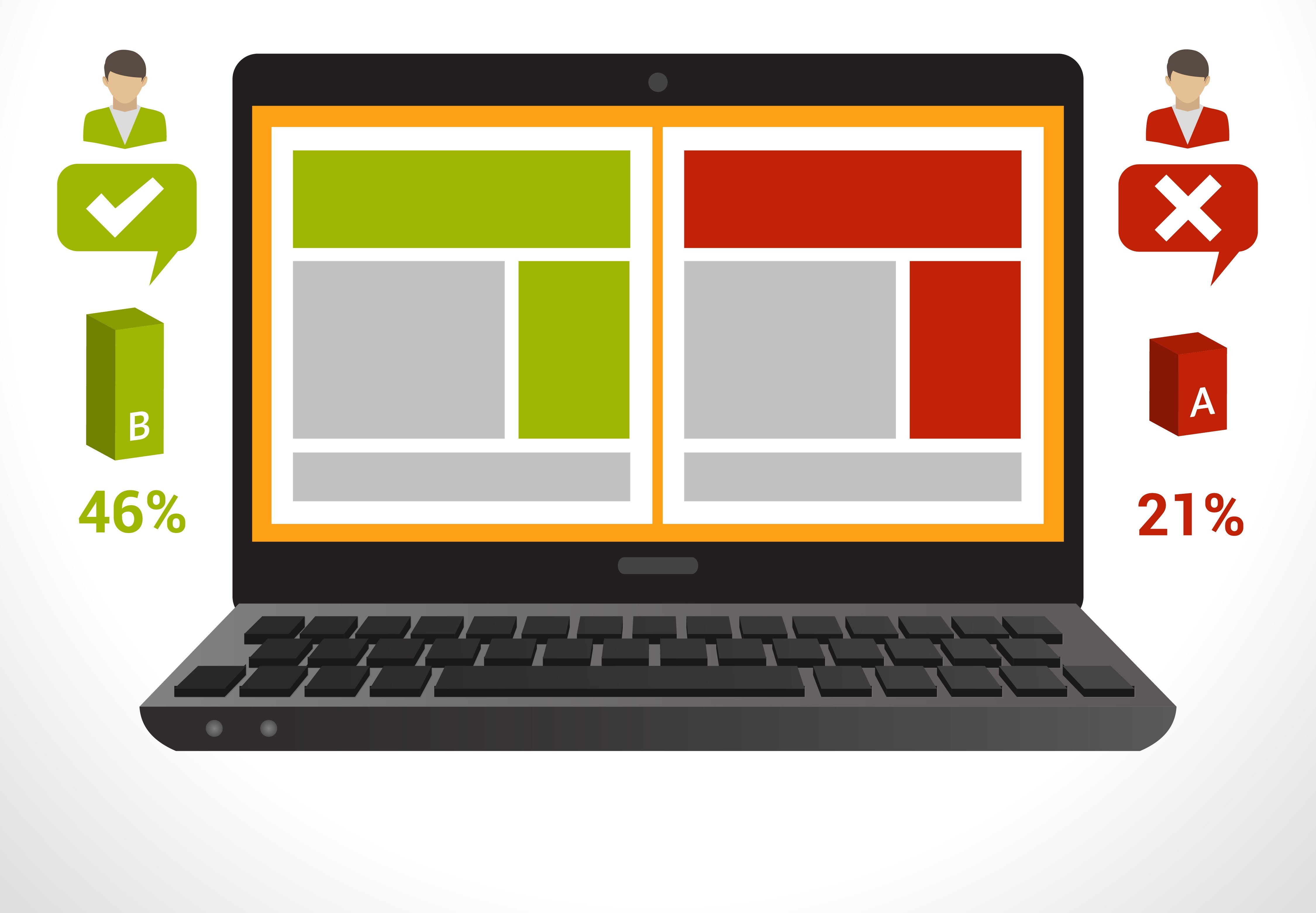
A/B testing, also called split testing, pits two versions of a webpage, ad, or email against each other. You measure a specific metric like click-through rate, conversion rate, bounce rate, or whatever matters for that test. And the version that performs better wins.
Picture two landing pages that are identical except for the call-to-action button. Version A shows a green button that says, “Buy Now.” Version B shows a red button that says, “Get Yours Today.” You split your traffic between the two pages and let visitors decide which one converts better. The winner becomes your new control, and you test the next idea against it. Repeat this cycle long enough, and you build a page that reflects what your actual audience responds to, not what your team assumed they’d like.
What are the types of A/B testing?
Three main approaches cover most testing programs.
A simple A/B test changes one variable at a time. It can be a headline, a CTA, a button color. So, you can isolate exactly what drove the change in performance.
Multivariate testing, or MVT, changes several elements at once and measures how they interact with each other. This approach tells you not just which elements work, but how they work together.
Split URL testing compares two entirely different URLs. Consider testing two distinct landing page layouts instead of swapping individual elements on a single page.
Whichever method you pick, the goal stays the same: compare versions, measure performance, and learn something about your audience you didn’t know before.
Why does A/B testing matter?
Before you run your first test, it helps to know why this work earns a place on your roadmap.
Data-driven decisions beat guesswork, even for marketers with twenty years of experience. A/B testing converts opinions into concrete answers and lowers the risk of betting on a hunch that doesn’t pan out.
Continuous optimization keeps you ahead of competitors who test relentlessly while you wait for certainty. Small, steady gains stack up into significant performance improvements over a year, and frequent testing helps you adapt as user preferences shift.
Resource efficiency matters when budgets are tight. Testing in a controlled environment shows you which strategies actually work before you scale spending behind them. It is a critical advantage in performance marketing, where every dollar needs to earn its ROAS.
A better user experience follows naturally. Test enough designs, messages, and flows, and you start to understand what genuinely makes the journey smoother for the people using it.
How do you run an A/B test, step by step?
A solid A/B test consists of several critical components. Understanding each element ensures that the test is both methodologically sound and actionable. Remember that A/B testing is not a one-off effort; it’s a cycle of constant iteration.
How do you identify testing opportunities?
Open your analytics platform before you write a single hypothesis. Google Analytics or Adobe Analytics will show you exactly where visitors stall — high bounce rates, abandoned carts, drop-off points in the funnel. Heatmaps add another layer. They show where people actually click, scroll, and hover. It often reveals that visitors ignore your main CTA entirely or click on something that isn’t even a button.
If your product pages pull in thousands of visitors a day but few of them finish checkout, you’ve found your first test. Customer feedback fills in the gaps that analytics can’t show you. Surveys, session recordings, and reviews surface friction points that numbers alone won’t explain.
How do you build a testing roadmap?
Once you have decided on the things you will be testing for your website, make a roadmap for the continuous improvement of your website. The two parts for an effective optimization are:
Create a backlog: List every element worth testing based on what your data and feedback turned up and let that list grow as new ideas surface.
Next up is prioritizing based on potential impact. Rank each idea by expected impact, how hard it is to build, and how well it ties back to your business goals. The tests with the highest potential upside and the lowest lift usually go first.
How do you write a strong hypothesis?
Every solid test starts with a hypothesis you can prove or disprove. State what you’re changing, what you expect to happen, and why. For example: “Changing our CTA text from ‘Submit’ to ‘Download Free Guide’ will increase click-through rate by at least 10%.” A hypothesis like this gives you a clear pass-or-fail line once the test wraps up.
Which metrics should you track?
Decide what you’re measuring before the test goes live. Most teams default to a single conversion goal, but that narrow view can hide real value. Track multiple metrics per test, and you’ll often catch benefits you didn’t expect. A product demo video tested for bounce rate might also lift time on page, newsletter signups, and social shares — numbers that never show up if you only watch one metric.
How should you split your traffic?
Most tests split traffic 50/50 between Version A and Version B. Some teams use weighted splits or bandit algorithms instead, which shift traffic toward the better-performing variant as the test runs, rather than waiting until the end to declare a winner.
How long should you run a test for statistical significance?
Run your test long enough to trust the result. The right duration depends on your traffic volume, your current conversion rate, and the confidence level you’re targeting —95% is the standard benchmark. Stop too early, and you risk a false positive or a false negative based on noise rather than a real pattern. Tools like Optimizely, Google Optimize, or VWO calculate significance for you, so you don’t have to guess.
How do you analyze results and take action?
When the test ends, look past the headline number. Check the percentage lift, the confidence level, and any ripple effects on other metrics. Ship the winning variation if the result is clear. Pull whatever insight you can from it and feed that into your next test if the result is inconclusive.
Three checks keep your analysis honest: confirm the numbers track with historical trends, verify you’ve hit your required sample size, and account for anything external like a promotion, a seasonal spike, a site outage that could have skewed the result.
What should you do after the test ends?
Every test ends one of three ways: your variation wins, your control holds, or the result is inconclusive. Each outcome teaches you something if you look closely enough. Check your secondary metrics along with the primary one — a test built to reduce bounce rate might also move conversion rate in a direction worth noting.
Write down the full process: the hypothesis, the setup, what you found. That record saves the next person on your team from re-running a test you already ran, and it builds institutional knowledge over time.
To keep a testing program running at scale, revisit your past winners with new variations, space out tests so they don’t interfere with each other, run separate tests on separate pages at the same time, and keep a shared calendar so nobody duplicates work.
A/B testing rewards patience and repetition. Every test, win or lose, teaches you something about the customer you’re trying to reach.
How can you use A/B testing to improve Ad performance?
On-site testing gets most of the attention, but the same logic works just as well on Google Ads, Facebook Ads, LinkedIn Ads, and anywhere else you spend media dollars.
Test your ad copy and creative directly against each other. Use different value props, headlines, calls to action, images, or color schemes. Let click and conversion data tell you which version actually resonates.
Keep your landing page aligned with the ad that sent the click. A strong ad with a mismatched landing page still loses the visitor. Matching your headline and messaging across both reduces bounce and keeps the experience consistent from click to conversion.
Audience segmentation deserves its own tests too. Run the same creative against different demographic groups, or layer interest-based targeting on top of demographic filters and watch how performance shifts between segments.
Budget allocation is testable as well. Platforms like Google Ads let you split spend across campaigns and see which segments or channels deliver the strongest ROI, so you can shift budget toward what’s working and cut what isn’t.
Testing your ad performance this way improves the campaigns you’re running right now and help gather valuable insights that inform other marketing channels.
How does A/B testing affect your overall conversion rate?
Conversion rate sits at the center of most marketing dashboards, whether you’re chasing product sales, software signups, or newsletter subscriptions.
Some tests move CVR directly. Change a critical step in the checkout flow, and you’ll often see the impact in your analytics almost immediately, since you can track exactly which variant produced each conversion.
Other tests move CVR indirectly. A shorter time on page might mean visitors found what they needed faster. A lower bounce rate might mean your messaging finally landed. These signals build toward higher conversions over time, even when the connection isn’t obvious in the moment.
Combine your data sources to get the full picture. Quantitative data like analytics, heatmaps or click maps tells you what happened. Qualitative data like surveys and user testing tells you why. You need both to understand a result well enough to act on it with confidence.
A 5% lift in CVR doesn’t sound like much on its own. Stack two or three wins like that every quarter, though, and the compounding effect turns into a meaningful jump in revenue by year’s end.
Is A/B testing worth the effort?
Yes, if you treat it as a habit rather than a one-off project. A/B testing gives you a structured way to keep improving instead of guessing. One successful test isn’t the finish line; it’s proof that the next one is worth running. Share what you learn across your team, including the tests that fail, and keep refining. Form a hypothesis, run the experiment, act on what you find, and repeat. That cycle is what actually moves conversion rates, ad performance, and the overall user experience.
Frequently asked questions
How long should an A/B test run?
It depends on your traffic volume, your current conversion rate, and the confidence level you want. As a general rule, run the test until you hit a 95% confidence level, or until a significance calculator tells you that you have enough data to trust the result.
What happens if my test doesn’t show a clear winner?
An inconclusive result usually means one of three things: you didn’t get enough traffic, the change was too subtle to register, or the change simply didn’t matter to your users. Try revising the hypothesis, gathering more data, or testing something bolder next time.
Can I test multiple elements at the same time?
You can, through multivariate testing. Keep in mind that MVT needs more traffic than a simple A/B test to reach statistical significance, since it’s measuring more combinations at once.
How do I avoid false positives in my results?
Stick to your planned test duration and required sample size and resist the urge to peek at results early and call the test before it’s ready. Most A/B testing platforms include built-in safeguards that flag this risk for you.
Which tools work best for A/B testing?
Attryb Personalize, Adobe Target, and GA4’s experiment features are all solid options. The right one depends on your budget, your traffic levels, and how much technical setup your team can handle.
Attryb Personalize allows you to run A/B tests on on-site content and popups so you can measure the incremental benefits.
Is A/B testing only useful for large companies?
Not at all. Smaller companies benefit just as much, though lower traffic means you’ll need more patience to collect enough data for a confident result. The insights you get are just as valuable either way.
How do I decide what to test first?
Start with the low-hanging fruit like pages with high visibility and high potential impact. CTA buttons, checkout pages, and landing page headlines are usually the best places to begin. \
What’s the difference between A/B testing and multivariate testing?
A/B testing isolates one change at a time, so you know exactly what caused the result. Multivariate testing changes several elements at once and shows you how those elements interact with each other, which gives you more insight but requires more traffic to reach a reliable conclusion.
Do I need a large amount of traffic to run a valid test?
Higher traffic gets you to a confident result faster, but low-traffic sites can still run valid tests. You’ll just need to let the test run longer, and you may want to focus on bigger, bolder changes that are more likely to produce a measurable difference.
Can I run more than one A/B test at the same time?
Yes, as long as the tests run on different pages or different parts of your site where they won’t interact with each other. Running overlapping tests on the same page or the same audience segment can muddy your results, so space them out or keep them isolated.
Marketers used to trust their gut. A few years of rising ad costs and shrinking margins changed that. Today, growth comes from testing, measuring, and refining, not from hunches about what an audience wants.
A/B testing gives you a way to do exactly that. You run two versions of something, measure the difference, and let real user behavior settle the argument.
What is A/B testing?
A/B testing, also called split testing, pits two versions of a webpage, ad, or email against each other. You measure a specific metric like click-through rate, conversion rate, bounce rate, or whatever matters for that test. And the version that performs better wins.
Picture two landing pages that are identical except for the call-to-action button. Version A shows a green button that says, “Buy Now.” Version B shows a red button that says, “Get Yours Today.” You split your traffic between the two pages and let visitors decide which one converts better. The winner becomes your new control, and you test the next idea against it. Repeat this cycle long enough, and you build a page that reflects what your actual audience responds to, not what your team assumed they’d like.
What are the types of A/B testing?
Three main approaches cover most testing programs.
A simple A/B test changes one variable at a time. It can be a headline, a CTA, a button color. So, you can isolate exactly what drove the change in performance.
Multivariate testing, or MVT, changes several elements at once and measures how they interact with each other. This approach tells you not just which elements work, but how they work together.
Split URL testing compares two entirely different URLs. Consider testing two distinct landing page layouts instead of swapping individual elements on a single page.
Whichever method you pick, the goal stays the same: compare versions, measure performance, and learn something about your audience you didn’t know before.
Why does A/B testing matter?
Before you run your first test, it helps to know why this work earns a place on your roadmap.
Data-driven decisions beat guesswork, even for marketers with twenty years of experience. A/B testing converts opinions into concrete answers and lowers the risk of betting on a hunch that doesn’t pan out.
Continuous optimization keeps you ahead of competitors who test relentlessly while you wait for certainty. Small, steady gains stack up into significant performance improvements over a year, and frequent testing helps you adapt as user preferences shift.
Resource efficiency matters when budgets are tight. Testing in a controlled environment shows you which strategies actually work before you scale spending behind them. It is a critical advantage in performance marketing, where every dollar needs to earn its ROAS.
A better user experience follows naturally. Test enough designs, messages, and flows, and you start to understand what genuinely makes the journey smoother for the people using it.
How do you run an A/B test, step by step?
A solid A/B test consists of several critical components. Understanding each element ensures that the test is both methodologically sound and actionable. Remember that A/B testing is not a one-off effort; it’s a cycle of constant iteration.
How do you identify testing opportunities?
Open your analytics platform before you write a single hypothesis. Google Analytics or Adobe Analytics will show you exactly where visitors stall — high bounce rates, abandoned carts, drop-off points in the funnel. Heatmaps add another layer. They show where people actually click, scroll, and hover. It often reveals that visitors ignore your main CTA entirely or click on something that isn’t even a button.
If your product pages pull in thousands of visitors a day but few of them finish checkout, you’ve found your first test. Customer feedback fills in the gaps that analytics can’t show you. Surveys, session recordings, and reviews surface friction points that numbers alone won’t explain.
How do you build a testing roadmap?
Once you have decided on the things you will be testing for your website, make a roadmap for the continuous improvement of your website. The two parts for an effective optimization are:
Create a backlog: List every element worth testing based on what your data and feedback turned up and let that list grow as new ideas surface.
Next up is prioritizing based on potential impact. Rank each idea by expected impact, how hard it is to build, and how well it ties back to your business goals. The tests with the highest potential upside and the lowest lift usually go first.
How do you write a strong hypothesis?
Every solid test starts with a hypothesis you can prove or disprove. State what you’re changing, what you expect to happen, and why. For example: “Changing our CTA text from ‘Submit’ to ‘Download Free Guide’ will increase click-through rate by at least 10%.” A hypothesis like this gives you a clear pass-or-fail line once the test wraps up.
Which metrics should you track?
Decide what you’re measuring before the test goes live. Most teams default to a single conversion goal, but that narrow view can hide real value. Track multiple metrics per test, and you’ll often catch benefits you didn’t expect. A product demo video tested for bounce rate might also lift time on page, newsletter signups, and social shares — numbers that never show up if you only watch one metric.
How should you split your traffic?
Most tests split traffic 50/50 between Version A and Version B. Some teams use weighted splits or bandit algorithms instead, which shift traffic toward the better-performing variant as the test runs, rather than waiting until the end to declare a winner.
How long should you run a test for statistical significance?
Run your test long enough to trust the result. The right duration depends on your traffic volume, your current conversion rate, and the confidence level you’re targeting —95% is the standard benchmark. Stop too early, and you risk a false positive or a false negative based on noise rather than a real pattern. Tools like Optimizely, Google Optimize, or VWO calculate significance for you, so you don’t have to guess.
How do you analyze results and take action?
When the test ends, look past the headline number. Check the percentage lift, the confidence level, and any ripple effects on other metrics. Ship the winning variation if the result is clear. Pull whatever insight you can from it and feed that into your next test if the result is inconclusive.
Three checks keep your analysis honest: confirm the numbers track with historical trends, verify you’ve hit your required sample size, and account for anything external like a promotion, a seasonal spike, a site outage that could have skewed the result.
What should you do after the test ends?
Every test ends one of three ways: your variation wins, your control holds, or the result is inconclusive. Each outcome teaches you something if you look closely enough. Check your secondary metrics along with the primary one — a test built to reduce bounce rate might also move conversion rate in a direction worth noting.
Write down the full process: the hypothesis, the setup, what you found. That record saves the next person on your team from re-running a test you already ran, and it builds institutional knowledge over time.
To keep a testing program running at scale, revisit your past winners with new variations, space out tests so they don’t interfere with each other, run separate tests on separate pages at the same time, and keep a shared calendar so nobody duplicates work.
A/B testing rewards patience and repetition. Every test, win or lose, teaches you something about the customer you’re trying to reach.
How can you use A/B testing to improve Ad performance?
On-site testing gets most of the attention, but the same logic works just as well on Google Ads, Facebook Ads, LinkedIn Ads, and anywhere else you spend media dollars.
Test your ad copy and creative directly against each other. Use different value props, headlines, calls to action, images, or color schemes. Let click and conversion data tell you which version actually resonates.
Keep your landing page aligned with the ad that sent the click. A strong ad with a mismatched landing page still loses the visitor. Matching your headline and messaging across both reduces bounce and keeps the experience consistent from click to conversion.
Audience segmentation deserves its own tests too. Run the same creative against different demographic groups, or layer interest-based targeting on top of demographic filters and watch how performance shifts between segments.
Budget allocation is testable as well. Platforms like Google Ads let you split spend across campaigns and see which segments or channels deliver the strongest ROI, so you can shift budget toward what’s working and cut what isn’t.
Testing your ad performance this way improves the campaigns you’re running right now and help gather valuable insights that inform other marketing channels.
How does A/B testing affect your overall conversion rate?
Conversion rate sits at the center of most marketing dashboards, whether you’re chasing product sales, software signups, or newsletter subscriptions.
Some tests move CVR directly. Change a critical step in the checkout flow, and you’ll often see the impact in your analytics almost immediately, since you can track exactly which variant produced each conversion.
Other tests move CVR indirectly. A shorter time on page might mean visitors found what they needed faster. A lower bounce rate might mean your messaging finally landed. These signals build toward higher conversions over time, even when the connection isn’t obvious in the moment.
Combine your data sources to get the full picture. Quantitative data like analytics, heatmaps or click maps tells you what happened. Qualitative data like surveys and user testing tells you why. You need both to understand a result well enough to act on it with confidence.
A 5% lift in CVR doesn’t sound like much on its own. Stack two or three wins like that every quarter, though, and the compounding effect turns into a meaningful jump in revenue by year’s end.
Is A/B testing worth the effort?
Yes, if you treat it as a habit rather than a one-off project. A/B testing gives you a structured way to keep improving instead of guessing. One successful test isn’t the finish line; it’s proof that the next one is worth running. Share what you learn across your team, including the tests that fail, and keep refining. Form a hypothesis, run the experiment, act on what you find, and repeat. That cycle is what actually moves conversion rates, ad performance, and the overall user experience.
Frequently asked questions
How long should an A/B test run?
It depends on your traffic volume, your current conversion rate, and the confidence level you want. As a general rule, run the test until you hit a 95% confidence level, or until a significance calculator tells you that you have enough data to trust the result.
What happens if my test doesn’t show a clear winner?
An inconclusive result usually means one of three things: you didn’t get enough traffic, the change was too subtle to register, or the change simply didn’t matter to your users. Try revising the hypothesis, gathering more data, or testing something bolder next time.
Can I test multiple elements at the same time?
You can, through multivariate testing. Keep in mind that MVT needs more traffic than a simple A/B test to reach statistical significance, since it’s measuring more combinations at once.
How do I avoid false positives in my results?
Stick to your planned test duration and required sample size and resist the urge to peek at results early and call the test before it’s ready. Most A/B testing platforms include built-in safeguards that flag this risk for you.
Which tools work best for A/B testing?
Attryb Personalize, Adobe Target, and GA4’s experiment features are all solid options. The right one depends on your budget, your traffic levels, and how much technical setup your team can handle.
Attryb Personalize allows you to run A/B tests on on-site content and popups so you can measure the incremental benefits.
Is A/B testing only useful for large companies?
Not at all. Smaller companies benefit just as much, though lower traffic means you’ll need more patience to collect enough data for a confident result. The insights you get are just as valuable either way.
How do I decide what to test first?
Start with the low-hanging fruit like pages with high visibility and high potential impact. CTA buttons, checkout pages, and landing page headlines are usually the best places to begin. \
What’s the difference between A/B testing and multivariate testing?
A/B testing isolates one change at a time, so you know exactly what caused the result. Multivariate testing changes several elements at once and shows you how those elements interact with each other, which gives you more insight but requires more traffic to reach a reliable conclusion.
Do I need a large amount of traffic to run a valid test?
Higher traffic gets you to a confident result faster, but low-traffic sites can still run valid tests. You’ll just need to let the test run longer, and you may want to focus on bigger, bolder changes that are more likely to produce a measurable difference.
Can I run more than one A/B test at the same time?
Yes, as long as the tests run on different pages or different parts of your site where they won’t interact with each other. Running overlapping tests on the same page or the same audience segment can muddy your results, so space them out or keep them isolated.
Share:
Share:

Founder and CEO

Boost Sales Now
Join the leading D2C brands leveraging Attryb to deliver personalized experiences that drive measurable growth


Boost Sales Now
Join the leading D2C brands leveraging Attryb to deliver personalized experiences that drive measurable growth


Boost Sales Now
Join the leading D2C brands leveraging Attryb to deliver personalized experiences that drive measurable growth


