Back to blogs

Tutorials

Cart Abandonment Recovery: Advanced Strategies to Boost E-commerce Sales

By

Sachin Tyagi

VP of Growth

1 min read

Image by pch.vector on Freepik
Table Of Contents

Share with your community:

Table Of Contents
Table Of Contents
Table Of Contents

Share with your community:

Tl;DR

  • Cart abandonment costs e-commerce brands roughly 70% of potential sales, and the highest-performing teams are moving past basic reminder emails to fix the problem at its root.

  • AI-powered propensity-scoring flags at-risk shoppers before they leave, so brands can act early rather than react after the fact.

  • Behavioral segmentation tailors offers to different shopper types, such as repeat buyers versus first-timers, rather than sending the same message to everyone.

  • Mobile-first checkout design matters more than ever, since mobile abandonment rates are well above desktop rates.

  • Multichannel follow-up, combining email, SMS, and retargeting ads, recovers more sales than relying on a single channel.

  • The real driver of long-term recovery is continuous testing and personalization across the entire checkout experience, not discounts alone.

What Is Cart Abandonment, and why does it keep happening?

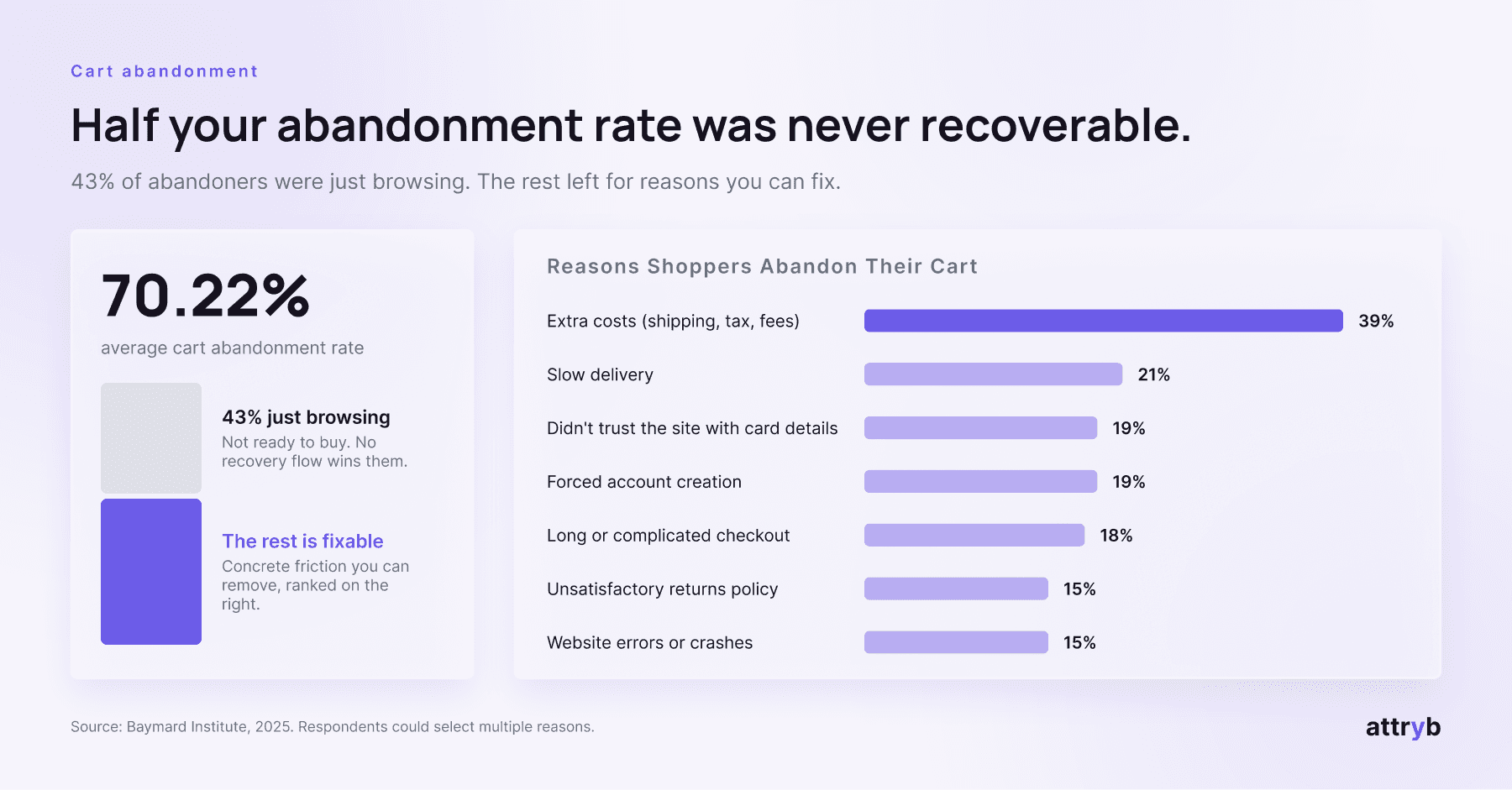
Cart abandonment occurs when customers add products to the shopping cart but do not complete the purchase. Cart abandonment rates for e-commerce stores across industries have averaged 70.19% (Baymard Institute, 2025). This means that 7 out of 10 customers who start the checkout process will abandon their carts and not complete their purchases for various reasons. 

Cart abandonment can occur for a variety of reasons. Some customers may abandon their shopping cart if they are surprised by additional costs, such as shipping fees that appear at checkout. Others may be deterred by lengthy forms that need to be filled out on their mobile devices. Others still may never have bought from your online store before, and you are just one of several stores they are comparison shopping. Identifying which of these customer types are your abandoners can help you build the most effective recovery strategy. 

This guide will build upon our previous exploration of fundamental cart abandonment strategies and cover the advanced data-driven techniques. We will focus on strategies that high-performing e-commerce teams use to bring shoppers back and turn more browsers into buyers. 

How can data and analytics improve cart recovery?

Data and analytics help e-commerce companies understand why customers abandon their shopping carts and identify the most effective ways to recover them.

Advanced cart abandonment metrics that should be tracked
How do exit-intent statistics reveal checkout problems?

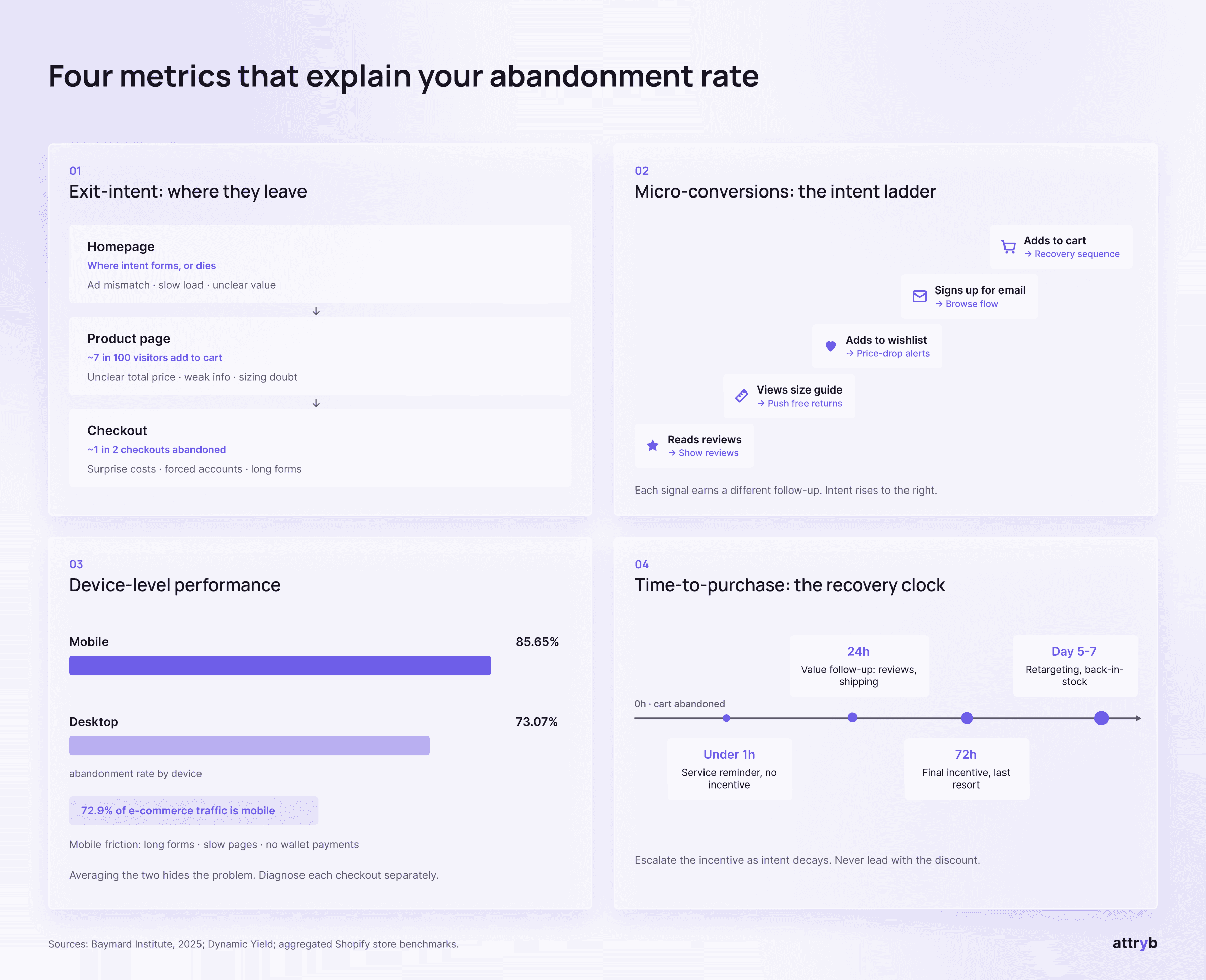
Exit-intent tracking highlights the specific point in the checkout process where customers abandon their shopping baskets. These insights help brands detect friction points such as unexpected additional shipping charges, confusing return policies, slow-loading pages, and even technical issues during checkout.

Tools like Hotjar and FullStory track cursor movement and scrolling behavior to uncover customer frustration earlier than traditional analytics platforms.

Why does micro-conversion tracking improve recovery rates?

Customers often don't complete their purchase immediately. They complete smaller actions along the way that indicate their purchase intent: browsing product pages, reading reviews, adding products to wish lists, and signing up for emails.

By tracking these micro-conversions rather than just purchases, the business gains much better insight into customers' buying behavior and intent.

Why should brands analyze device-level performance?

Shoppers using mobile devices to browse online abandon their shopping carts at a rate significantly higher than their desktop counterparts. Barilliance (2023) reported that mobile cart abandonment averages 85.65%, compared with 73.07% on desktop.

Mobile users often struggle with long checkout forms, poor mobile design, and slow page load times. Desktop users may abandon their shopping cart while comparing other products or questioning the payment process.

Analyzing and optimizing your checkout process separately for mobile and desktop users can help your company achieve higher conversion rates than a single checkout process for all shoppers.

How does time-to-purchase analysis improve cart recovery timing?

Some products customers purchase immediately, but many others they research for longer before purchasing. Fashion purchases often happen within hours, whereas electronics purchases may take several days.

Time-to-Purchase tracking reveals how long, on average, a customer takes to complete a purchase from the start of their research online. With this information, a company can send follow-up communications at the most opportune time to try and influence a purchase. For example, products that customers research online and then buy within hours may benefit from emails that are sent within a few hours of adding items to a cart or viewing a product.

How does behavioral segmentation improve cart recovery?

Behavioral segmentation helps brands personalize recovery campaigns instead of treating all abandoners the same way.  

Segmented campaigns generate stronger engagement and higher conversion rates compared to generic recovery emails.

Repeat shoppers vs. first-time visitors:

Industry research shows that repeat visitors convert up to 9 times more than new visitors in email recovery campaigns. Repeat visitors already trust your brand. First-time visitors often need reassurance before purchasing.

Repeat shoppers respond better to loyalty rewards, exclusive discounts, and personalized recommendations. First-time visitors respond better to trust badges, customer reviews, and guest checkout options.

Product category cohorts:

Abandonment reasons vary significantly by product category. As reported by Statista, the fashion abandonment rate is 68%, whereas the rate for specialized electronics is even higher, at over 78%. Customers buying electronics are interested in financing options or extended warranties, whereas customers buying fashion products are interested in topics like free return shipping. Thus, the same recovery message does not work for these two customer groups.

Promotional vs. full-price shoppers

Discount-driven shoppers behave differently from full-price buyers. Promotional shoppers typically respond better to limited-time offers, countdown timers, and exclusive discounts. Full-price shoppers often care more about product quality, fast shipping, and customer experience.

How does AI improve the effectiveness of cart recovery?

AI shifts cart recovery from reactive (responding after someone leaves) to proactive (identifying who's likely to leave and acting before they do).

  • Propensity scoring uses machine learning to analyze dozens of variables: browsing patterns, past purchases, time on site, demographic signals, and assigns each visitor a score that predicts their likelihood of buying. High-propensity shoppers might convert with just a gentle reminder. Low-propensity shoppers may need a stronger incentive, such as free shipping or a discount.

  • Next-Best-Action algorithms determine the most effective recovery channel for each shopper in real time. One customer might respond to SMS but tune out email. Another might convert after seeing a customer review rather than a discount. AI figures out which lever to pull for each person.

  • Dynamic Content Optimization is a tool that helps improve landing pages and ads by adjusting the wording, images, and calls to action to best fit the person who sees them. Personalization happens automatically based on what the person has done before. So, instead of trying different ad versions to see which works best, the system keeps making adjustments on its own to achieve the best results. You don't have to waste time trying to figure out what works and what doesn't - you can focus on making the most of what's already working.

How can on-site engagement reduce cart abandonment?

Interactive experiences keep shoppers engaged during checkout.

Gamified experiences create stronger emotional motivation to complete purchases than traditional checkout flows.

Interactive elements that reduce abandonment

Why do reward-based progress bars improve checkout completion?

Progress indicators show shoppers how close they are to free shipping, loyalty rewards, and bonus gifts. This approach creates momentum and encourages customers to continue shopping.

How do spin-to-win overlays re-engage visitors?  

Spin-to-win overlays add interactivity, excitement, and an element of chance. Gamified offers attract more attention and increase engagement rates compared to generic popups.

Why do loyalty point calculators increase conversion rates?

Real-time loyalty tracking activates loss aversion psychology. Customers feel more motivated when they see rewards accumulating during checkout.

How does A/B testing improve checkout performance?

A/B testing helps brands identify which checkout experiences generate the most conversions. Continuous testing yields measurable improvements over assumption-based design changes.

  • Button placement and color: The position and color of your "Proceed to Checkout" button changes behavior more than most teams expect. Brands should test button color, placement, its size, and text to find what drives the most clicks for your audience.

  • Copy and urgency messaging: A headline such as 'Complete Your Purchase Now and Get Free Shipping' versus 'Secure Your Items Before They Go Out of Stock' can create significant variation in conversions, depending on the products you sell and the audience you target. Remember to test it rather than just guessing how it will work.

  • Form simplification: Long checkout forms create friction. Streamlined forms reduce effort and improve completion rates compared to multi-page checkouts. Test a single-page checkout against a multi-step checkout form to see whether removing a single field can reduce abandoned checkouts.

How do you optimize checkout for mobile shoppers?

Over 72.9% of all e-commerce-traffic is generated from mobile devices (Statista, 2023). So, you naturally start with mobile optimization.

  • Mobile-first design: The growing share of e-commerce traffic from mobile devices means the checkout page needs to adopt a mobile-first approach. As Google has previously outlined, delivering a mobile-first checkout process can help to dramatically cut abandonment rate, with the optimized process reducing abandonment by up to 33% compared to an adapted desktop process.

  • Autofill and payment integrations: Enable Autofill for all fields in the checkout form and for integrated payment options (e.g., Apple Pay, Google Pay). This reduces the number of keystrokes your customer needs to enter their online payment card information for each purchase.

  • Load Speed: Another critical factor for e-commerce is your website's load speed. Studies have shown that increasing your website's load time by 1 second can lead to a 7% increase in conversion rates. This means that by optimizing your code and implementing a content delivery network (CDN) to load your website as quickly as possible for users, you can dramatically improve your conversion rates.

How do multichannel recovery campaigns recover more sales?

Multichannel recovery campaigns reach customers through multiple touchpoints. It improves visibility and engagement.

Highest-performing recovery channels

Email sequences:

Effective email sequences usually include:  

  1. A reminder email  

  2. A value-focused follow-up  

  3. A final incentive offer

Structured sequences recover more abandoned carts than single-email campaigns. 

Retargeting ads:

Retargeting ads remind shoppers about abandoned products across Facebook, Instagram, and Google Display Network. Advanced retargeting campaigns also address objections directly and highlight relevant reviews.

SMS delivers faster engagement:

SMS messages achieve extremely high open rates. SMS delivers faster customer responses than email and works especially well for mobile shoppers.

What's the right timing and frequency for recovery messages?

Immediate follow-up (within 2–4 hours): Whatever distracted the shopper likely still exists if you message them in the first few minutes. Give it a little time and reach out while the purchase is still fresh.

Staggered reminders: Space messages across 24 and 72 hours. Sending too many messages in a short amount of time will be considered spam by the shopper and may even harm your brand relationship with them.

Offer escalation: Service message first, then offer free shipping as a middle-point incentive. Price reduction should be used as a last-resort offer to attempt to recover a customer. This approach recovers customers without training them to hold out for a deal every time they shop.

What checkout improvements reduce abandonment at the decision point?

One-Click Purchasing: As Amazon's 1-Click patent expired in 2017, you can now offer one-click purchasing to your customers as well. This feature removes all friction for repeat customers who have stored their payment details during checkout for previous purchases.

Guest Checkout: Almost 37% of customers are deterred from buying online because they are forced to create an account before completing their purchase. Allow customers to complete their purchase first and then give them the option to sign up afterward.

Trust Seals and Security Certificates: A recognized security badge near the payment form gives hesitant shoppers the final nudge they need. Dynamic systems that surface these seals alongside customer reviews mentioning safe transactions are especially effective.

How does dynamic pricing help recover carts?

Real-Time Price Adjustments: For products with flexible margins, adjusting offers based on cart value, browsing behavior, and inventory levels can tip a wavering shopper toward buying. Sophisticated systems factor in time of day and customer history to make these calls automatically.

Bundled Incentives: As an alternative to discounting the core product, items highly relevant to it can be bundled with it to increase the average order value of completed transactions. For example, a camera retailer could promote a camera with a memory card and a cleaning kit. Bundling offers the potential to increase the average order value by 10-30% whilst reducing the abandoned shopping cart rate. This is an attractive trade-off for retailers.

Personalized Promotions: To recover carts, online retailers typically target specific audiences with tailored offers. Premium customers would likely get the most value from early access, whereas other customers would likely get the most value from a generic 10% off promotion. Matching incentive types to customer segments makes recovery campaigns significantly more efficient.

How do you recover carts from shoppers you can't identify?

Anonymous visitors pose the toughest challenge. You don't have an email address or phone number, so direct outreach isn't an option. But several strategies exist to move the needle.

Real-Time identity resolution

Real-Time Identity Resolution technologies allow anonymous website visitors to be linked to known customer data stored in that website's Customer Relationship Management (CRM) database. A variety of cross-device identification technologies, as well as probabilistic matching methods, are used for identity resolution, such as browser fingerprinting, cookie syncing, and IP address mapping.

Probabilistic matching calculates the probability of identification between unknown and known data sets using advanced Machine Learning algorithms. Although probabilistic matching is not 100% accurate, real-time identity resolution can increase a website's recoverable audience by 30-40%.

Exit-Intent overlays

Advanced exit-intent detection doesn't just track cursor movement. It monitors scroll depth, tab switching, and other micro-signals of potential abandonment. When these signals fire, a well-timed overlay can capture an email address or phone number before the shopper leaves.

The pitch needs to be worth their while. Early access to deals, personalized product recommendations, or a relevant quiz ("Find Your Perfect Skincare Routine") give visitors a reason to share their contact info.

Location-Based social proof widgets

Location-based social proof messages increase conversion rates when shown on product pages and cart pages. When set up correctly, these messages can indicate that 15 people in a nearby city or town have recently purchased the same item the current visitor is looking at. Scarcity messages that show how many items of similar products are left to buy with same-day delivery in the shopper’s location can also increase conversion rates when shown alongside social proof messages.

Tiered progress bar

A tiered progress bar shows the shopper their progress towards reaching a specific threshold such as free shipping, a special gift, or even a promo code. For example, “Add $12.50 more to qualify for free shipping,” with a progress bar showing how much is needed to reach the free shipping threshold, versus a static “Free shipping on orders over $50” message. Shoppers hate to leave money on the table, and the progress bar will prompt them to complete their purchase to achieve their goal, as do loyalty points.

What are the most important takeaways from cart recovery?

Successful cart recovery requires a combination of:

  • Advanced analytics

  • Personalized segmentation

  • Mobile optimization

  • Multichannel engagement

  • Continuous testing

Brands that combine these strategies outperform businesses that rely only on basic reminder emails. Long-term success comes from improving the entire customer journey rather than focusing only on discounts.

Conclusion: How can brands continuously improve cart recovery?

Cart abandonment recovery requires ongoing optimization, testing, and personalization.

A mix of analytics, AI, mobile experiences, behavioral segments, and multi-channel approaches (e.g., email, SMS, and push notifications) will deliver far better results for cart abandonment recovery than traditional methods for retrieving abandoned shopping carts in e-commerce stores.

The most successful online shops address cart recovery over the long term. It is part of the customer experience and not a short-term sales campaign.

Frequently Asked Questions

  1. What is a good cart abandonment rate for e-commerce stores?

    The abandonment rates for most e-commerce sites sit around the 60% to 80% mark. Those who optimize their checkout process can lower the abandonment rate than the industry average.


  2. Why do shoppers abandon carts most often?

    The main reasons for cart abandonment are: Unexpected costs, Complex checkout processes, Slow loading times of the website, Compulsory registration for new customers.


  3. Are SMS recovery campaigns better than email campaigns?

    SMS campaigns typically have a faster reaction from customers and higher open rates than email campaigns. However, email is more detailed than SMS. So, the best way to recover online abandoned carts is by using a combination of both channels.


  4. How does AI improve cart recovery?

    Artificial Intelligence helps to predict customer behaviour; it personalizes messages and suggests the best steps for recovery to sales representatives.


  5. Why is mobile optimization important for cart recovery?

    Mobile shoppers abandon carts more often due to smaller screens, slow load times, and difficult form entry.


  6. How many abandoned cart emails should brands send?

    Most successful recovery flows include 2–3 emails spread across 72 hours.


  7. Does offering discounts always improve cart recovery?

    Not always. Some shoppers respond better to trust signals, reviews, or free shipping than direct discounts.


  8. What recovery strategy works best for first-time shoppers?

    First-time shoppers are more likely to complete a purchase when given the opportunity by offering them a sense of trust, customer reviews, checking out as a guest and offering them secure payment options.


What Is Cart Abandonment, and why does it keep happening?

Cart abandonment occurs when customers add products to the shopping cart but do not complete the purchase. Cart abandonment rates for e-commerce stores across industries have averaged 70.19% (Baymard Institute, 2025). This means that 7 out of 10 customers who start the checkout process will abandon their carts and not complete their purchases for various reasons. 

Cart abandonment can occur for a variety of reasons. Some customers may abandon their shopping cart if they are surprised by additional costs, such as shipping fees that appear at checkout. Others may be deterred by lengthy forms that need to be filled out on their mobile devices. Others still may never have bought from your online store before, and you are just one of several stores they are comparison shopping. Identifying which of these customer types are your abandoners can help you build the most effective recovery strategy. 

This guide will build upon our previous exploration of fundamental cart abandonment strategies and cover the advanced data-driven techniques. We will focus on strategies that high-performing e-commerce teams use to bring shoppers back and turn more browsers into buyers. 

How can data and analytics improve cart recovery?

Data and analytics help e-commerce companies understand why customers abandon their shopping carts and identify the most effective ways to recover them.

Advanced cart abandonment metrics that should be tracked

How do exit-intent statistics reveal checkout problems?

Exit-intent tracking highlights the specific point in the checkout process where customers abandon their shopping baskets. These insights help brands detect friction points such as unexpected additional shipping charges, confusing return policies, slow-loading pages, and even technical issues during checkout.

Tools like Hotjar and FullStory track cursor movement and scrolling behavior to uncover customer frustration earlier than traditional analytics platforms.

Why does micro-conversion tracking improve recovery rates?

Customers often don't complete their purchase immediately. They complete smaller actions along the way that indicate their purchase intent: browsing product pages, reading reviews, adding products to wish lists, and signing up for emails.

By tracking these micro-conversions rather than just purchases, the business gains much better insight into customers' buying behavior and intent.

Why should brands analyze device-level performance?

Shoppers using mobile devices to browse online abandon their shopping carts at a rate significantly higher than their desktop counterparts. Barilliance (2023) reported that mobile cart abandonment averages 85.65%, compared with 73.07% on desktop.

Mobile users often struggle with long checkout forms, poor mobile design, and slow page load times. Desktop users may abandon their shopping cart while comparing other products or questioning the payment process.

Analyzing and optimizing your checkout process separately for mobile and desktop users can help your company achieve higher conversion rates than a single checkout process for all shoppers.

How does time-to-purchase analysis improve cart recovery timing?

Some products customers purchase immediately, but many others they research for longer before purchasing. Fashion purchases often happen within hours, whereas electronics purchases may take several days.

Time-to-Purchase tracking reveals how long, on average, a customer takes to complete a purchase from the start of their research online. With this information, a company can send follow-up communications at the most opportune time to try and influence a purchase. For example, products that customers research online and then buy within hours may benefit from emails that are sent within a few hours of adding items to a cart or viewing a product.

How does behavioral segmentation improve cart recovery?

Behavioral segmentation helps brands personalize recovery campaigns instead of treating all abandoners the same way.  

Segmented campaigns generate stronger engagement and higher conversion rates compared to generic recovery emails.

Repeat shoppers vs. first-time visitors:

Industry research shows that repeat visitors convert up to 9 times more than new visitors in email recovery campaigns. Repeat visitors already trust your brand. First-time visitors often need reassurance before purchasing.

Repeat shoppers respond better to loyalty rewards, exclusive discounts, and personalized recommendations. First-time visitors respond better to trust badges, customer reviews, and guest checkout options.

Product category cohorts:

Abandonment reasons vary significantly by product category. As reported by Statista, the fashion abandonment rate is 68%, whereas the rate for specialized electronics is even higher, at over 78%. Customers buying electronics are interested in financing options or extended warranties, whereas customers buying fashion products are interested in topics like free return shipping. Thus, the same recovery message does not work for these two customer groups.

Promotional vs. full-price shoppers

Discount-driven shoppers behave differently from full-price buyers. Promotional shoppers typically respond better to limited-time offers, countdown timers, and exclusive discounts. Full-price shoppers often care more about product quality, fast shipping, and customer experience.

How does AI improve the effectiveness of cart recovery?

AI shifts cart recovery from reactive (responding after someone leaves) to proactive (identifying who's likely to leave and acting before they do).

  • Propensity scoring uses machine learning to analyze dozens of variables: browsing patterns, past purchases, time on site, demographic signals, and assigns each visitor a score that predicts their likelihood of buying. High-propensity shoppers might convert with just a gentle reminder. Low-propensity shoppers may need a stronger incentive, such as free shipping or a discount.

  • Next-Best-Action algorithms determine the most effective recovery channel for each shopper in real time. One customer might respond to SMS but tune out email. Another might convert after seeing a customer review rather than a discount. AI figures out which lever to pull for each person.

  • Dynamic Content Optimization is a tool that helps improve landing pages and ads by adjusting the wording, images, and calls to action to best fit the person who sees them. Personalization happens automatically based on what the person has done before. So, instead of trying different ad versions to see which works best, the system keeps making adjustments on its own to achieve the best results. You don't have to waste time trying to figure out what works and what doesn't - you can focus on making the most of what's already working.

How can on-site engagement reduce cart abandonment?

Interactive experiences keep shoppers engaged during checkout.

Gamified experiences create stronger emotional motivation to complete purchases than traditional checkout flows.

Interactive elements that reduce abandonment

Why do reward-based progress bars improve checkout completion?

Progress indicators show shoppers how close they are to free shipping, loyalty rewards, and bonus gifts. This approach creates momentum and encourages customers to continue shopping.

How do spin-to-win overlays re-engage visitors?  

Spin-to-win overlays add interactivity, excitement, and an element of chance. Gamified offers attract more attention and increase engagement rates compared to generic popups.

Why do loyalty point calculators increase conversion rates?

Real-time loyalty tracking activates loss aversion psychology. Customers feel more motivated when they see rewards accumulating during checkout.

How does A/B testing improve checkout performance?

A/B testing helps brands identify which checkout experiences generate the most conversions. Continuous testing yields measurable improvements over assumption-based design changes.

  • Button placement and color: The position and color of your "Proceed to Checkout" button changes behavior more than most teams expect. Brands should test button color, placement, its size, and text to find what drives the most clicks for your audience.

  • Copy and urgency messaging: A headline such as 'Complete Your Purchase Now and Get Free Shipping' versus 'Secure Your Items Before They Go Out of Stock' can create significant variation in conversions, depending on the products you sell and the audience you target. Remember to test it rather than just guessing how it will work.

  • Form simplification: Long checkout forms create friction. Streamlined forms reduce effort and improve completion rates compared to multi-page checkouts. Test a single-page checkout against a multi-step checkout form to see whether removing a single field can reduce abandoned checkouts.

How do you optimize checkout for mobile shoppers?

Over 72.9% of all e-commerce-traffic is generated from mobile devices (Statista, 2023). So, you naturally start with mobile optimization.

  • Mobile-first design: The growing share of e-commerce traffic from mobile devices means the checkout page needs to adopt a mobile-first approach. As Google has previously outlined, delivering a mobile-first checkout process can help to dramatically cut abandonment rate, with the optimized process reducing abandonment by up to 33% compared to an adapted desktop process.

  • Autofill and payment integrations: Enable Autofill for all fields in the checkout form and for integrated payment options (e.g., Apple Pay, Google Pay). This reduces the number of keystrokes your customer needs to enter their online payment card information for each purchase.

  • Load Speed: Another critical factor for e-commerce is your website's load speed. Studies have shown that increasing your website's load time by 1 second can lead to a 7% increase in conversion rates. This means that by optimizing your code and implementing a content delivery network (CDN) to load your website as quickly as possible for users, you can dramatically improve your conversion rates.

How do multichannel recovery campaigns recover more sales?

Multichannel recovery campaigns reach customers through multiple touchpoints. It improves visibility and engagement.

Highest-performing recovery channels

Email sequences:

Effective email sequences usually include:  

  1. A reminder email  

  2. A value-focused follow-up  

  3. A final incentive offer

Structured sequences recover more abandoned carts than single-email campaigns. 

Retargeting ads:

Retargeting ads remind shoppers about abandoned products across Facebook, Instagram, and Google Display Network. Advanced retargeting campaigns also address objections directly and highlight relevant reviews.

SMS delivers faster engagement:

SMS messages achieve extremely high open rates. SMS delivers faster customer responses than email and works especially well for mobile shoppers.

What's the right timing and frequency for recovery messages?

Immediate follow-up (within 2–4 hours): Whatever distracted the shopper likely still exists if you message them in the first few minutes. Give it a little time and reach out while the purchase is still fresh.

Staggered reminders: Space messages across 24 and 72 hours. Sending too many messages in a short amount of time will be considered spam by the shopper and may even harm your brand relationship with them.

Offer escalation: Service message first, then offer free shipping as a middle-point incentive. Price reduction should be used as a last-resort offer to attempt to recover a customer. This approach recovers customers without training them to hold out for a deal every time they shop.

What checkout improvements reduce abandonment at the decision point?

One-Click Purchasing: As Amazon's 1-Click patent expired in 2017, you can now offer one-click purchasing to your customers as well. This feature removes all friction for repeat customers who have stored their payment details during checkout for previous purchases.

Guest Checkout: Almost 37% of customers are deterred from buying online because they are forced to create an account before completing their purchase. Allow customers to complete their purchase first and then give them the option to sign up afterward.

Trust Seals and Security Certificates: A recognized security badge near the payment form gives hesitant shoppers the final nudge they need. Dynamic systems that surface these seals alongside customer reviews mentioning safe transactions are especially effective.

How does dynamic pricing help recover carts?

Real-Time Price Adjustments: For products with flexible margins, adjusting offers based on cart value, browsing behavior, and inventory levels can tip a wavering shopper toward buying. Sophisticated systems factor in time of day and customer history to make these calls automatically.

Bundled Incentives: As an alternative to discounting the core product, items highly relevant to it can be bundled with it to increase the average order value of completed transactions. For example, a camera retailer could promote a camera with a memory card and a cleaning kit. Bundling offers the potential to increase the average order value by 10-30% whilst reducing the abandoned shopping cart rate. This is an attractive trade-off for retailers.

Personalized Promotions: To recover carts, online retailers typically target specific audiences with tailored offers. Premium customers would likely get the most value from early access, whereas other customers would likely get the most value from a generic 10% off promotion. Matching incentive types to customer segments makes recovery campaigns significantly more efficient.

How do you recover carts from shoppers you can't identify?

Anonymous visitors pose the toughest challenge. You don't have an email address or phone number, so direct outreach isn't an option. But several strategies exist to move the needle.

Real-Time identity resolution

Real-Time Identity Resolution technologies allow anonymous website visitors to be linked to known customer data stored in that website's Customer Relationship Management (CRM) database. A variety of cross-device identification technologies, as well as probabilistic matching methods, are used for identity resolution, such as browser fingerprinting, cookie syncing, and IP address mapping.

Probabilistic matching calculates the probability of identification between unknown and known data sets using advanced Machine Learning algorithms. Although probabilistic matching is not 100% accurate, real-time identity resolution can increase a website's recoverable audience by 30-40%.

Exit-Intent overlays

Advanced exit-intent detection doesn't just track cursor movement. It monitors scroll depth, tab switching, and other micro-signals of potential abandonment. When these signals fire, a well-timed overlay can capture an email address or phone number before the shopper leaves.

The pitch needs to be worth their while. Early access to deals, personalized product recommendations, or a relevant quiz ("Find Your Perfect Skincare Routine") give visitors a reason to share their contact info.

Location-Based social proof widgets

Location-based social proof messages increase conversion rates when shown on product pages and cart pages. When set up correctly, these messages can indicate that 15 people in a nearby city or town have recently purchased the same item the current visitor is looking at. Scarcity messages that show how many items of similar products are left to buy with same-day delivery in the shopper’s location can also increase conversion rates when shown alongside social proof messages.

Tiered progress bar

A tiered progress bar shows the shopper their progress towards reaching a specific threshold such as free shipping, a special gift, or even a promo code. For example, “Add $12.50 more to qualify for free shipping,” with a progress bar showing how much is needed to reach the free shipping threshold, versus a static “Free shipping on orders over $50” message. Shoppers hate to leave money on the table, and the progress bar will prompt them to complete their purchase to achieve their goal, as do loyalty points.

What are the most important takeaways from cart recovery?

Successful cart recovery requires a combination of:

  • Advanced analytics

  • Personalized segmentation

  • Mobile optimization

  • Multichannel engagement

  • Continuous testing

Brands that combine these strategies outperform businesses that rely only on basic reminder emails. Long-term success comes from improving the entire customer journey rather than focusing only on discounts.

Conclusion: How can brands continuously improve cart recovery?

Cart abandonment recovery requires ongoing optimization, testing, and personalization.

A mix of analytics, AI, mobile experiences, behavioral segments, and multi-channel approaches (e.g., email, SMS, and push notifications) will deliver far better results for cart abandonment recovery than traditional methods for retrieving abandoned shopping carts in e-commerce stores.

The most successful online shops address cart recovery over the long term. It is part of the customer experience and not a short-term sales campaign.

Frequently Asked Questions

  1. What is a good cart abandonment rate for e-commerce stores?

    The abandonment rates for most e-commerce sites sit around the 60% to 80% mark. Those who optimize their checkout process can lower the abandonment rate than the industry average.


  2. Why do shoppers abandon carts most often?

    The main reasons for cart abandonment are: Unexpected costs, Complex checkout processes, Slow loading times of the website, Compulsory registration for new customers.


  3. Are SMS recovery campaigns better than email campaigns?

    SMS campaigns typically have a faster reaction from customers and higher open rates than email campaigns. However, email is more detailed than SMS. So, the best way to recover online abandoned carts is by using a combination of both channels.


  4. How does AI improve cart recovery?

    Artificial Intelligence helps to predict customer behaviour; it personalizes messages and suggests the best steps for recovery to sales representatives.


  5. Why is mobile optimization important for cart recovery?

    Mobile shoppers abandon carts more often due to smaller screens, slow load times, and difficult form entry.


  6. How many abandoned cart emails should brands send?

    Most successful recovery flows include 2–3 emails spread across 72 hours.


  7. Does offering discounts always improve cart recovery?

    Not always. Some shoppers respond better to trust signals, reviews, or free shipping than direct discounts.


  8. What recovery strategy works best for first-time shoppers?

    First-time shoppers are more likely to complete a purchase when given the opportunity by offering them a sense of trust, customer reviews, checking out as a guest and offering them secure payment options.

Share:

Share:

Sachin Tyagi

VP of Growth

Experienced Finance Professional with a demonstrated history of working in the financial services industry. Sachin leads our expansion and outreach. He's also an avid football fan.

Boost Sales Now

Join the leading D2C brands leveraging Attryb to deliver personalized experiences that drive measurable growth

Founder

Boost Sales Now

Join the leading D2C brands leveraging Attryb to deliver personalized experiences that drive measurable growth

Founder

Boost Sales Now

Join the leading D2C brands leveraging Attryb to deliver personalized experiences that drive measurable growth

Founder